
David Ben-Gurion, Israel’s first prime minister and longest-serving one until Benjamin Netanyahu eclipsed his record, is the subject of Yariv Mozer’s reverent documentary, Memories of Ben-Gurion, which is now available on the Izzy streaming platform.
Mozer, in this occasionally engaging 54-minute film, does not even attempt to paint a comprehensive portrait of Ben-Gurion, who was twice prime minister and once minister of defence. He intentionally ignores Ben-Gurion’s role as a towering political figure and one of Israel’s founding fathers. Instead, he focuses on his personality and habits.
He examines Ben-Gurion mainly through the eyes of people who worked for him during his double-barrelled premiership from 1948 to 1953 and 1956 to 1963.
The interviewees are ordinary men and women. Sarah Meltzer and Dalia Goren were his administrative secretaries from 1949 to 1954 and from 1961 to 1970 respectively. Their comments, personal in nature, are completely innocuous.
Moshik Theumim, his assistant in the Rafi Party, offers few comments of value as well. Ben-Gurion was instrumental in forming it after his defection from the ruling Labor Party.
Arale Scherft, his bodyguard from 1958 to 1960, is somewhat more forthcoming. He describes his boss as a determined individual who strictly adhered to daily routines, such as his one-hour walk each and every day.
Michael Bar-Zohar, a journalist and Ben-Gurion’s hand-picked biographer, has remarkably little to say about him in terms of substance.
Yariv Ben-Eliezer, one of his grandsons, hails him as a “profound thinker” who cast a giant shadow, but provides no examples.
In general, Ben-Gurion is viewed positively through broad generalities.
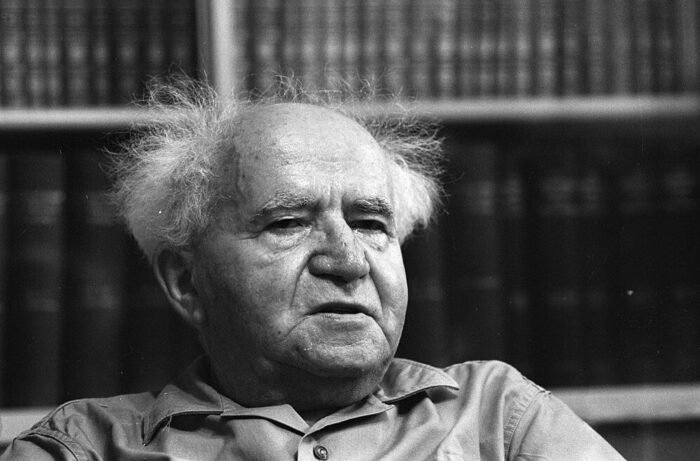
He was a secular Jew steeped in tradition who regarded the Bible as the history of the Jewish people.
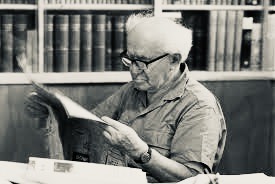
He was a bookworm who would often read through the night, turning off the lights at around 5 a.m. He amassed a library of 20,000 books, some of which can be found in a modest building in central Tel Aviv which used to be his home, but which has been a museum since his death in December 1973.
He would cut out newspaper articles about himself with a pen knife.
He did not smoke or drink and was not particularly interested in food. He wore a suit, but rarely a tie. He was not a master of small talk, but projected charisma when he entered a room. He enjoyed talking to his grandchildren, but did not play with them. Although he looked old, he exuded youthfulness. He liked to be called Ben-Gurion rather than Mr. Ben-Gurion.
He was phlegmatic, but burst into tears during a visit to Buenos Aires upon hearing students in a Jewish day school speaking fluent Hebrew.
In 1953, he and his wife, Paula, moved to Sde Boker, an austere and remote kibbutz in the Negev Desert. He lived modestly, sleeping in a simple hut and taking his meals in a communal dining hall.
Paula was his muse, and Mozer devotes the last portion of the film to her.

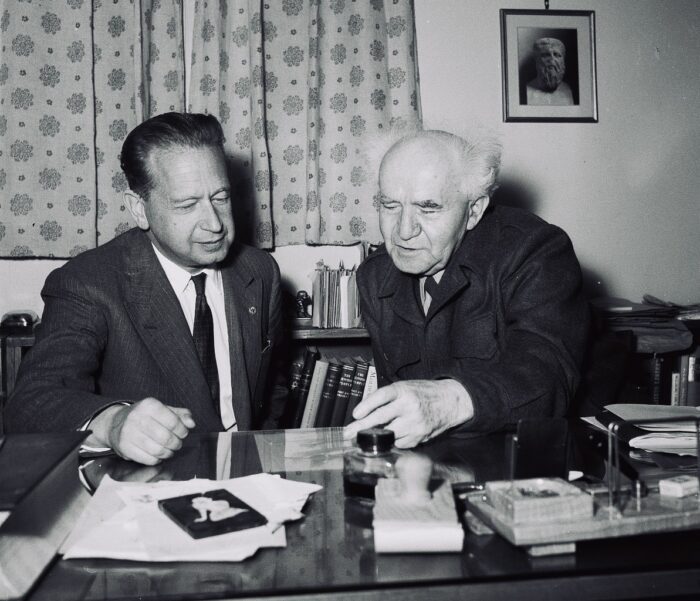
Although she preferred the city to the desert, she followed him selflessly to Sde Boker. Totally devoted to him, she knew he was destined for greatness when she met him. She lacked tact, but was was sociable and kind. When the secretary general of the United Nations, Dag Hammarskjold, visited the kibbutz in 1958, she gave up her room for him.
Memories of Ben-Gurion is mildly interesting, but it just scratches the surface and leaves a viewer with more questions than answers. Mozer could have delved deeper, but he chose to keep everything on a fleeting and superficial level.