
Israel has taken a giant leap forward to ensure that a two-state solution remains a two-state illusion.
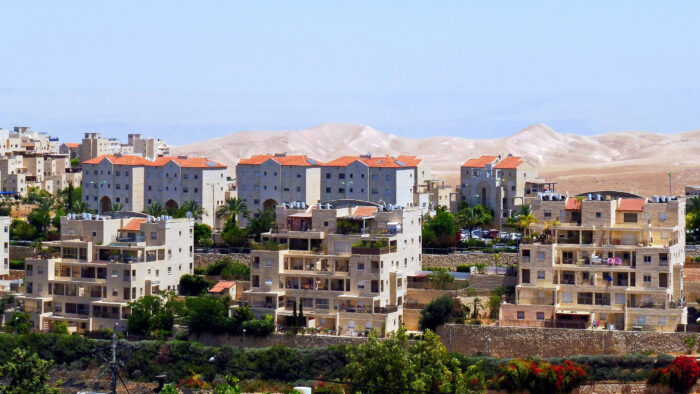
Several days ago, Finance Minister Bezalel Smotrich announced that 3,000 housing units would be built in the E1 tract of land between Jerusalem and the settlement of Ma’ale Adumim.
This ambitious project “buries the idea of a Palestinian state,” said Smotrich, a champion of the settlement movement and a minister in the Ministry of Defence responsible for civilian issues in the West Bank.
“After decades of international pressure and freezes, we are breaking conventions and connecting Ma’ale Adumim to Jerusalem,” he said. “This is Zionism at its best — building, settling and strengthening our sovereignty in the Land of Israel.”
Prime Minister Benjamin Netanyahu remained conspicuously silent, but Smotrich said he had his full support. As he put it at a ceremony in Ma’ale Adumim, “He backs me up in everything concerning Judea and Samaria.”
Foreign Minister Gideon Sa’ar publicly endorsed Smotrich’s plan, while dismissing the concept of Palestinian statehood and the prospects of a two-state solution. “Who said it’s the solution? It’s probably the problem. I say it’s the two-state illusion.”
As Smotrich and Sa’ar well know, continued development in E1, one of the last geographic links between the West Bank cities of Ramallah and Bethlehem, would slice the West Bank in two segments, sever East Jerusalem’s territorial contiguity with them, and render the creation of a viable Palestinian state virtually impossible.
Although Smotrich partly characterized his announcement as a rebuke to countries, such as France, Britain, Canada and Australia, that have recognized Palestinian statehood of late, it is probable that he was emboldened by the pro-Israel sentiments of U.S. President Donald Trump and the United States’ ambassador in Israel, Mike Huckabee.

Thanking them both for their support, Smotrich said they understand that “a Palestinian state would endanger the existence of Israel,” and that the West Bank is “an inseparable part of our land.”
Smotrich, a settler himself, has asked Netanyahu to release the brakes and “apply Israeli sovereignty in Judea and Samaria.”
Netanyahu has yet to do this, but the E1 project is clearly another unilateral maneuver by Israel to consolidate its grip on the West Bank, which it has occupied since the 1967 Six Day War.
Since returning to office in December 2022, Netanyahu has authorized the construction of more than 30 settlements, some of which were previously built without government permission and have been granted retroactive authorization.
The new construction is regarded as the largest wave of government-sanctioned settlement activity in the West Bank in decades.
In addition, Jewish settlers have built 130 outposts, a record number, in the past two years, mostly in rural areas of the West Bank. Unauthorized and illegal, they are often tolerated by the Israeli government.
The Palestinian Authority, which was established during the first phase of the 1993 Oslo peace process, has denounced Israel’s plans as “a challenge to international legitimacy and international law.” The chairman of the Palestinian National Council, Rawhi Fattouh, said that Smotrich’s plan “falls within the framework of a de facto creeping annexation policy” and “aligns” Netanyahu with the “vision of ‘Greater Israel.’”
The Foreign Ministry of Jordan, one of the few Arab countries that have signed a peace treaty with Israel, has condemned it as “an assault on the inalienable right of the Palestinian people to establish their independent, sovereign state on the lines of June 4, 1967, with Jerusalem as its capital.”
Russia, China and Western nations have denounced Smotrich’s move as well. And the European Union’s representative for foreign affairs, Kaja Kallas, has said that it “further undermines” the two-state solution.
Amid these denunciations, the United Nations Office for the Coordination of Humanitarian Affairs reports that Jewish settlers in the West Bank carried out more than 750 attacks on Palestinians and their property during the first half of this year, an average of nearly 130 assaults a month.
This is the highest monthly average since the United Nations started compiling such records 19 years ago.
The Israeli army has also recorded a surge in settler violence, but it has documented 440 attacks during the same period. The Israel Defence Force, the sovereign power in the West Bank, says it tries to prevent attacks. But it has obviously failed to rein in violent settlers, who represent a small minority of the approximately 500,000 settlers living in the West Bank.
Settler violence has erupted against the backdrop of Israel’s continual efforts to tighten its grip on the West Bank, which is inhabited by about three million Palestinians.

Last week, Defence Minister Israel Katz said that Israeli troops will remain deployed in northern West Bank refugee camps at least until the end of 2025.
Since launching Operation Iron Wall in January, the Israeli army has carried out a concerted offensive against Palestinians suspected of engaging in terrorism. The military campaign began in the Jenin refugee camp, adjacent to Jenin, and was subsequently extended into the Tulkarem and Nur Shams camps, near the city of Tulkarem in the western West Bank.
Israel’s ongoing operation has eradicated terrorist cells and has kept Israelis safer, but it also has pushed the notion of Palestinian statehood deeper into purgatory, an objective shared by Smotrich, Netanyahu and his entire cabinet.
Despite their fervent opposition to a Palestinian state, they may be fighting a Sisyphian battle. At last count, almost 150 countries have come out in favor of Palestinian statehood.
Israel, one of the very few holdouts, finds itself on the wrong side of the ledger. Israel should not be an occupying power and should recognize the legitimate national aspirations of the Palestinians within the parameters of a negotiated, phased-in agreement to create a demilitarized Palestinian state.