
Canonized by the Vatican in 1992, five decades after he was murdered in the Auschwitz-Birkenau concentration camp, the Franciscan priest Maximilian Kolbe was by all accounts a saintly man and a proud Pole.
He was incarcerated in Auschwitz in May 1941, when virtually all of its inmates were Polish political prisoners and its image as a Jewish killing ground and horrific symbol of the Holocaust had yet to be etched into the consciousness of mankind.
Anthony D’Ambrosio’s intensely-felt movie, Triumph of the Heart, unfolds over the course of several months during that year, presenting Kolbe as a selfless person who sacrificed himself to save a fellow Pole.
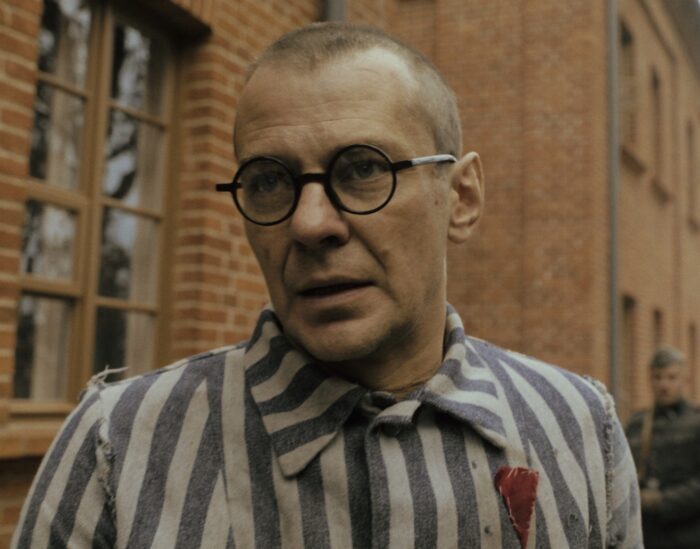
The film was screened in its world premiere in Warsaw on August 13, and will hit theaters in the United States on September 12.
Written and directed by D’Ambrosio, it is mostly dark and somber, with shards of light shining through it.
Much it takes place in a grim Auschwitz cell, but flashbacks resurrect prewar Poland, where Kolbe was a successful publisher, and preview Japan, where he attempted to spread the gospel.
The first scene occurs in a gritty yard in Auschwitz as Karl Fritzsch (Christopher Sherwood), the deputy commandant, inspects a downtrodden line of Polish prisoners clad in striped uniforms. An inmate has escaped, and Fritzsch is there to exact vengeance by selecting prisoners to be sent to their deaths in a starvation cell.
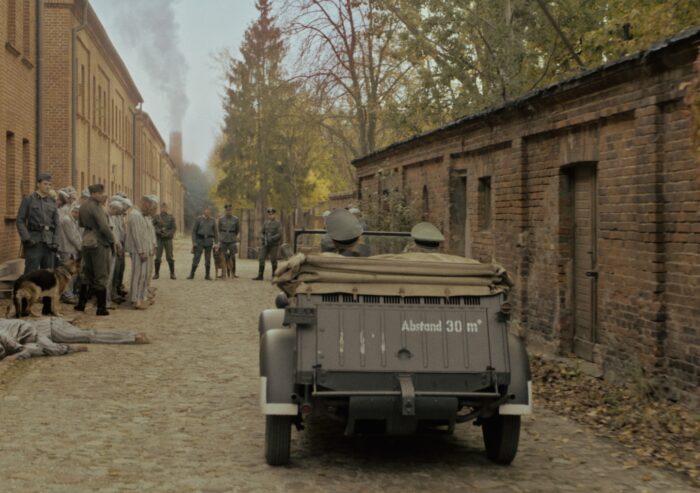
When one of them breaks down in tears after singled out for punishment, Kolbe (Marcin Kwasny) steps forward and volunteers to take his place. Fritzsch accepts his unexpected offer with alacrity.
The cell in which they languish is composed of a rainbow of Poles, from pious Catholics to staunch communists. But as far as Kolbe is concerned, they are all Poles and their differences should be forgotten.
In this connection, he asks a fellow prisoner named Herschel, presumably a Polish Jew, to pray with him. Shortly afterward, the Hebrew words from a common Jewish prayer are heard.
The film, nevertheless, glosses over Kolbe’s relationship with Jews.
Although he was an exemplary figure, he shared some of the antisemitic stereotypes widespread in Poland before World War II. He considered Freemasons “an organized clique of fanatical Jews, who want to destroy the church.” And he cited the Protocols of the Elders of Zion, a notorious antisemitic booklet concocted by the czarist Russian police, as “important proof” that “the founders of Zionism” intended to subjugate “the entire world.”
In short, Kolbe believed the conspiracy theory that Freemasonry and “international Zionism” were the guiding forces of “atheistic communism.”
The “Jewish question,” however, was of minor importance in Kolbe’s work, with only 31 of his 14,000 letters referencing Jews or Judaism. In some, he expressed a missionary zeal supporting the conversion of Jews to Christianity.
During World War II, Kolbe’s monastery at Niepokalanów sheltered Polish Jews seeking a safe haven. Judging by the postwar testimony of a local Pole, Kolbe encouraged Poles to show kindness toward Jews. “When Jews came to me asking for a piece of bread, I asked Father Maximilian if I could give it to them in good conscience, and he answered me, ‘Yes, it is necessary to do this because all men are our brothers.'”
During his brief imprisonment in Auschwitz, Kolbe exhibited the qualities that prompted Pope John Paul II, a fellow Pole, to recommend him to sainthood.
Kolbe encouraged his cellmates to behave like human beings rather than animals, even as they were subjected to gratuitous beatings by cruel guards and torn by hunger and thirst.
In graphic scenes illustrating their desperation, they catch a rat and ravenously devour it, then suck water from rags that have been drenched by a downpour.
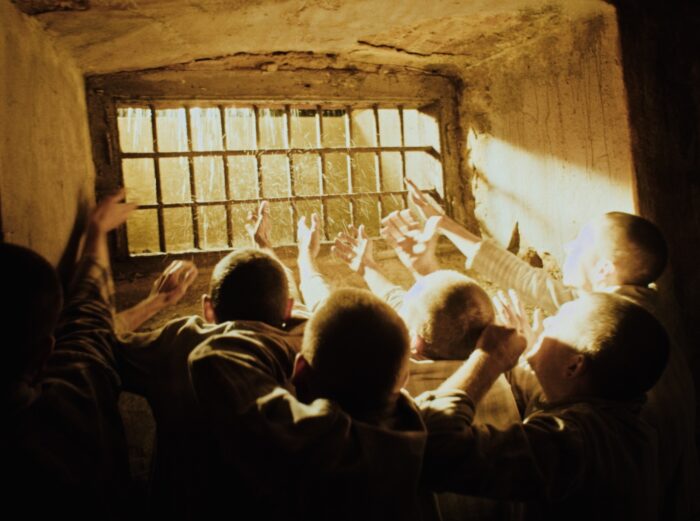
With Kolbe’s encouragement, they sing Polish patriotic songs to underline the point that they have not been morally defeated. And when a prisoner wants to confess his sins, Kolbe obliges, never wavering from his belief that their shortcomings can be forgiven.
Triumph of the Heart paints a heroic picture of a saintly Pole who rose to the occasion during his darkest hour, but by no means is it a fully rounded portrait of Kolbe.