
Benjamin Netanyahu is under mounting pressure to either end or escalate the Israel-Hamas war in the Gaza Strip.
The nearly two-year war, the longest in Israel’s history, has torn the country asunder.
While the majority of Israelis have called for an immediate ceasefire to facilitate the release of the remaining hostages in Gaza, Netanyahu, backed by hardliners in his right-wing coalition, wants to finish off Hamas once and for all, an objective that may be beyond Israel’s reach.
This burning issue came to a head following massive anti-war rallies in Israel last week and current reports that Hamas had agreed to a two-month ceasefire brokered by Egypt and Qatar.
On August 17, upwards of one million protesters across Israel demanded an immediate truce with Hamas to free the captives. Later that day, more than 400,000 people turned up at a rally in and around a plaza in Tel Aviv known as Hostages Square.
The demonstrations took place as Israel prepared to launch a military operation to seize Gaza City, a Hamas stronghold that Israel attacked during the early stages of the war in the autumn of 2023, following Hamas’ invasion of the western Negev on October 7.
To no one’s surprise, Netanyahu was critical of the demonstrations. “Those who call for ending the war without defeating Hamas are not only hardening Hamas’ position and distancing the release of our hostages,” he said. “They are also ensuring that the atrocities of October 7 will repeat themselves again and again, and that our sons and daughters will have to fight again and again in an endless war.”
“To make progress on the release of the hostages and to ensure that Gaza will no longer be a threat to Israel, we must complete the mission and defeat Hamas,” he added.
Yesterday, Defence Minister Israel Katz said that 60,000 new reservists will be called up, while 20,000 reservists will have their orders extended.
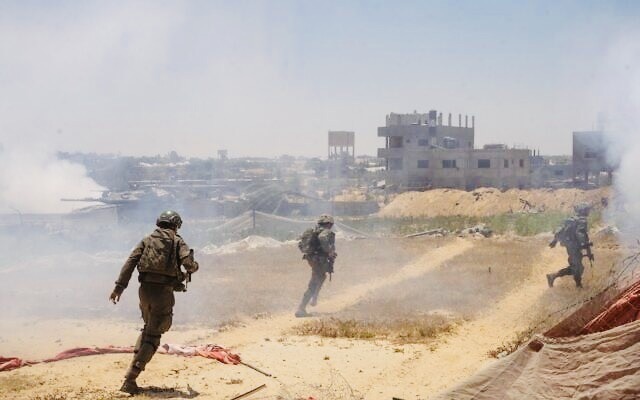
In any event, the preparatory phases of Israel’s planned offensive in Gaza have already begun. Two brigades have been operating in the Zeitoun neighborhood on the outskirts of Gaza City, and one brigade has moving around the Kafr Jabalia area, north of the city.
The proposed operation will be “gradual, precise and targeted” and will extend into areas of Gaza City where Israeli soldiers have not yet entered, The New York Times reported on August 20.
Meanwhile, in the vicinity of Khan Younis, Israel killed at least 10 Hamas operatives who attacked an Israeli encampment with the intention of kidnapping soldiers. Three soldiers were wounded, one of them seriously.
Earlier this month, Israel killed Jihad Kamal Salem Najjar in an air strike. He participated in the invasion of Kibbutz Nir Oz on October 7 and abducted Yarden Bibas, whose wife and infant children were murdered by Hamas.
Israel has yet to officially respond to the Egyptian and Qatari truce proposal, which calls for the release of 10 living Israeli hostages, 18 deceased ones, and up to 200 Palestinian prisoners. Talks to end the war and kick start an Israeli withdrawal from Gaza also would be on the agenda.
Finance Minister Bezalel Smotrich has rejected the proposal, having dismissed it as a “partial deal that abandons half of the hostages and that could lead to the suspension of the war in defeat.”
Another hardliner, National Security Minister Itamar Ben Gvir, warned Netanyahu that he does not have a “mandate to go to a partial deal.”
Smotrich’s cabinet colleague, Orit Strock, a member of his Religious Zionist Party, reminded Netanyahu that his first priority should be the defeat of Hamas rather than the return of the hostages.
These sharp critiques have been duly noted by Netanyahu, whose longevity as prime minister is dependent on their continuing support. Smotrich and Ben Gvir have both threatened to bolt if Netanyahu ends the war prematurely.
It would appear that Netanyahu has no intention of endorsing a partial agreement of the kind that Hamas seems to have accepted.
Last week, he suggested that Israel was no longer interested in a deal that would leave half of the living hostages as prisoners. “I think that is behind us,” he said.
Netanyahu’s conditions for ending the war remain intact. As he put it recently, “We insist not only that Hamas be disarmed, but also that Israel enforces the demilitarization (of Gaza) over time through continuous action against any attempt at rearmament.”
He said that Israel will hold the Philadelphia corridor along Gaza’s border with Egypt and maintain a security perimeter around Gaza.
U.S. President President Trump appears to be in alignment with Netanyahu’s position. As he wrote on his social media site last week, “We will only see the return of the remaining hostages when Hamas is confronted and destroyed!!! The sooner this takes place, the better the chances of success will be.”
Steve Witkoff, Trump’s special envoy to the Middle East, told families of Israeli hostages recently that Trump wants to see all the living hostages released at once.
“No piecemeal deals, that doesn’t work,” Witkoff said. “Now we think that we have to shift this negotiation to ‘all or nothing’ — everybody comes home. We have a plan around it.”
It is debatable whether Netanyahu will stick to his guns or settle for another partial deal. In the meantime, Israel is gearing up for a big push into Gaza City.
In short, the situation remains in flux.