
As one Western country after another recognizes the increasingly popular but polarizing idea of Palestinian statehood, Israel takes tangible and controversial steps to sabotage it.
In the past few weeks, France, Britain, Canada, Australia and Belgium have joined close to 150 countries that already have recognized a Palestinian state within the framework of a two-state solution.
Yesterday, the United Nations General Assembly endorsed a non-binding resolution calling for a two-state solution minus the involvement of Hamas. The resolution, proposed by France, also demanded the release of all Israeli and foreign hostages in Hamas captivity and condemned Hamas’ attack inside Israel on October 7, 2023.
One hundred and forty-two countries favored the declaration. Twelve nations, including Israel and the United States, voted against it. Israel characterized it as “reward” for Hamas, which rejects a two-state solution.
Prior to the latest development, the Israeli government, led by Prime Minister Benjamin Netanyahu, said that Israel will do whatever it can to block the formation of a sovereign Palestinian state in the West Bank and the Gaza Strip.
Netanyahu’s former national security advisor, Meir Ben-Shabbat, rejects that notion in the latest edition of Foreign Affairs. As he puts it, “There can be no two-state solution because the leaders of the Palestinian Authority and many Palestinians continue to reject the legitimacy of Israel’s existence. A May 2025 poll found that nearly half the Palestinians in the West Bank believed that armed struggle was the best way to get to a Palestinian state. Any type of lasting solution acceptable to Israel will require the Palestinians to reject terrorism in both word and deed and commit to accepting Israel as a sovereign Jewish state.”
At least several Israeli cabinet ministers who agree with Ben-Shabbat’s hawkish view, most notably Finance Minister Bezalel Smotrich, have demanded the annexation of parts of the West Bank.

This past July, the Knesset passed a non-binding motion in favor of annexing the West Bank. The resolution, adopted by a margin of 71-13, referred to it as “an inseparable part of the Land of Israel, the historical, cultural and spiritual homeland of the Jewish people.” The motion noted that “Israel has the natural, historical and legal right to all of the territories of the Land of Israel.”

In the wake of the vote, the speaker of the Knesset, Amir Ohana, said, “This is our home. The Land of Israel belongs to the people of Israel.”
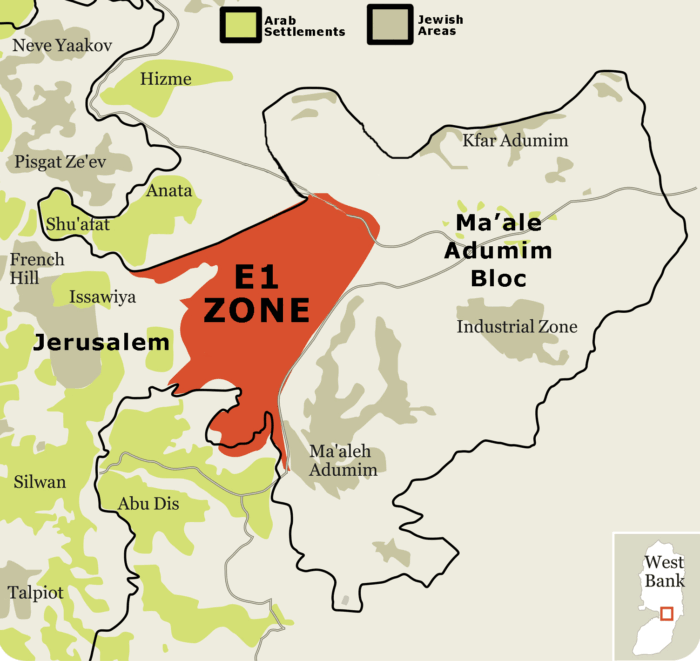
In light of these developments, no one could be surprised by Netanyahu’s announcement on September 11 that Israel will go ahead with the E-1 plan, a long-delayed construction project near Jerusalem intended to tighten Israel’s grip on the West Bank, bisect it into two separate segments, and cut it off from East Jerusalem.
“We are going to fulfill our promise that there will be no Palestinian state,” he said in no uncertain terms. “This place belongs to us.”
Netanyahu was specifically referring E-1, or East-1, a roughly 12-square kilometer tract of land north of the settlement of Maale Adumim, where 3,412 housing units will be built in the near future at a cost of approximately $1 billion.
This project is in line with Smotrich’s proposal on September 3 to annex 82 percent of the West Bank and thereby gain a “maximum of territory and a minimum Arab population.”
Under the plan, Israel would annex Area B and Area C of the West Bank, where Israeli settlements and army bases are located. Area A, dotted with Palestinian towns such as Ramallah and Nablus, would be left in the hands of the Palestinian Authority.
“It is time to apply Israeli sovereignty in Judea and Samaria and remove once and for all the idea of dividing our small land and establishing a terrorist state in its heart,” said Smotrich, using the biblical names for the West Bank.
This is not the first time Israel has spoken of annexing the West Bank.
In 2020, after U.S. President Donald Trump unveiled a peace proposal under which Israel would annex portions of the West Bank, Netanyahu mulled the possibility of annexing the Jordan Valley.
He dropped the matter after a warning from the United Arab Emirates, one of the first Arab states to join the Abraham Accords.
In the wake of Smotrich’s proposal earlier this month, Lana Nusseibeh, a United Arab Emirates diplomat, warned Israel not to proceed with annexation. It would would be “a red line” for her government, bring “no lasting peace,” and end (Israel’s) “vision of regional integration,” she said.
According to the Washington Post, Netanyahu recognized the importance of her warning by cancelling a cabinet meeting on September 4 that was due to discuss annexation.
This does not mean that Israel has abandoned annexation, which, if implemented, would have dire consequences.
It would surely destroy the two-state principle once and for all. It would sharply heighten tensions with the Palestinians in the West Bank and Gaza. It could possibly endanger Israel from a demographic perspective over the long term. It could jeopardize the Abraham Accords and further isolate Israel in the international community.
On the other hand, it is debatable whether annexation could lead to a historic clash with the United States under the Trump presidency.

The U.S. ambassador to Israel, Mike Huckabee, said recently that the Trump administration is unlikely to intervene in the debate concerning annexation. “The U.S. has never asked Israel to not apply sovereignty,” he said. “I have repeatedly stated that the U.S. respects Israel as a sovereign nation and will not tell Israel what to do.”
Huckabee added that Secretary Marco Rubio, who was due to arrive in Israel today for a visit, agrees with him.
However, a poll released by on September 11 by the progressive Alliance for Middle East Peace coalition indicates that most Americans, including Republicans who support Trump, oppose annexation.
It remains to be seen whether the current Israeli government will factor these considerations into its calculations before heading toward annexation. Netanyahu knows that the application of Israeli sovereignty in the West Bank would have major repercussions that would not be to Israel’s advantage.