
Alex Kurzem was a very, very unusual Holocaust survivor.
He survived as a mascot in a Latvian police unit that had been implicated in the mass murder of Jews.
Dan Goldberg, an Australian journalist, tells his amazing story in The Jewish Nazi?, a documentary that will be available on major digital platforms from September 12 onward.
Kurzem was five or six years old when the Jewish inhabitants of his village in what is now Belarus were rounded up by fascist forces and fatally shot. On the eve of the atrocity, his mother told him they would all die together. Driven by a need to survive, he escaped before Latvian policemen allied with the Germans entered the village.
Goldberg’s opening narrative is murky. He does not inform us how many Jews lived in the village, when the pro-German forces arrived, and how many Jews perished in that genocidal operation.
In any event, Kurzem fled into the woods as winter approached. To stay warm, he wore a coat he had removed from the body of a dead soldier in a field. And to keep hunger at bay, he plucked food from the pockets of deceased soldiers.
Goldberg does not tell us how long Kurzem survived in the forest before he was picked up in a snowdrift by a Latvian policeman named Kulis. Taking pity on the boy, Kulis brought him back to his base. Adopted by the battalion as a mascot, he was given a Latvian name, Uldis Kurzemnieks, as well as an army uniform and a miniature rifle. By this juncture, the battalion was attached to a German SS unit.
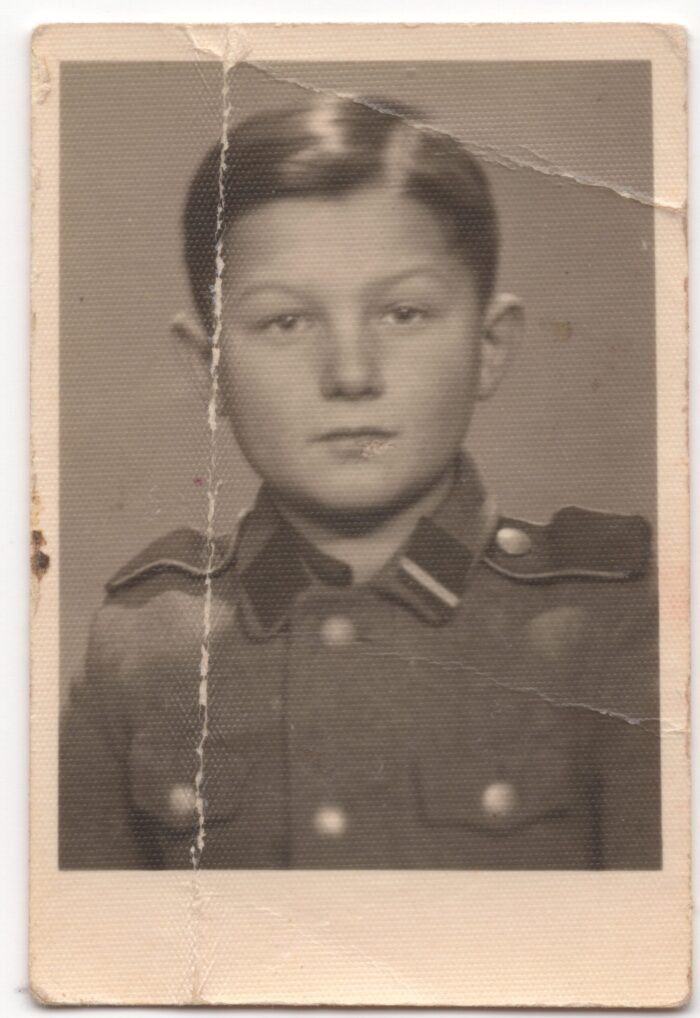
For the next two years, he accompanied the battalion as it committed atrocities against partisans and Jews. He also appeared in a 1943 Nazi propaganda film.
Although circumcised, he was able to pass as a Christian because of his blond hair and blue eyes. Goldberg does not explain how he managed to survive despite his circumcision. He had to pretend he hated Jews.
To protect him, the battalion arranged for Kurzem to be adopted by a Latvian family headed by Jekabs Dzenis. They immigrated to Australia in 1949, settling in Melbourne, a city that would be populated by a considerable number of Holocaust survivors.
During this period, Kurzem was tormented by an identity crisis. “I had to pretend I was not a Jew,” he says.
He was, in effect, two people in one body.
Throughout all these years, he suppressed his memories of the war and remained silent. “I had to keep it a secret,” he says.
In another omission, Goldberg fails to fill in viewers with details of his upbringing in Melbourne. Nor are we told about the woman he married and with whom he had children.
As the film unfolds, we learn that Kurzem became a television repairman, that he visited Belarus, where he discovered his real name, and that his adult son visited close relatives in Montreal.
Goldberg met Kurzem about 20 years ago in his capacity as the editor of the Australian Jewish News. “He was a highly traumatized individual and was living in borderline poverty,” he says. “When he finally started telling his story, he was met with resistance from both sides. He had been living his life as a Latvian in Melbourne, and when he revealed his Jewishness, he was accused of being a fraud by both the Jewish community and the Latvian community. I think it was incredibly hard for him to take.”
In 2007, Kurzem’s eldest son, Mark, published the story of his father’s life in a bestselling memoir, The Mascot, which produced tangible proof of his wartime ordeal. For decades, Kurzem had kept two sepia photographs of himself, dressed in a Latvian SS uniform, in a battered suitcase.
As Goldberg notes, the book aroused controversy.
Maris Lakis, a Dzenis family member, hotly disputed his father’s portrayal as a Nazi supporter. In vain, he demanded that the publisher pulp the book.
Lonnie Kulis, the son of the Latvian soldier who stumbled upon Kurzem in a forest, denied his father was an antisemitic killer.

The book attracted international attention. In 2009, the U.S. television show 60 Minutes ran a segment on Kurzem. Shortly afterward, ABC TV broadcast a documentary on his life.
One can understand why Kurzem’s odyssey was so riveting. This was a boy who defied the odds at a time when Jews in Nazi-occupied Europe were being mercilessly murdered. It unfolds in The Jewish Nazi? in all its twists and turns.