
Stella Goldschlag was both a victim and a perpetrator in Nazi Germany.
As a Jew, she was constantly persecuted and in danger of being deported to a concentration camp in Poland. Yet because she turned in Jews to the Gestapo to save herself and her parents, she became a Nazi collaborator and an infamous traitor.
Kilian Riedhof’s two-hour feature film, Stella: A Life, which will be available on VOD and digital platforms on October 3, skillfully recounts her journey to infamy.

The movie starts in Berlin in 1940, when Jews were still allowed to leave Germany. Stella (Paula Beer), then 18 years old, is a singer in a Jewish jazz club. She is presented as an easygoing person who seems oblivious to the tumult around her.

Her parents, having unsuccessfully applied for a U.S. visa, are keenly aware that they face uncertainty and the prospect of murder in a country whose fascist government is dedicated to exterminating Jews not only in Germany but in every Nazi-occupied European nation.
In an abrupt segue, the film transitions to 1943. Stella, clad in a drab uniform with a yellow Star of David on her lapel, is working in an arms factory alongside her mother. Conditions are difficult, but they can be thankful because they have yet to be deported. When police raid the premises, Stella’s husband, Fred, is caught and arrested.
Ever resourceful, Stella joins a forgery ring churning out false identity papers for Jews and dissidents who can afford the hefty price. She works closely with a Jew named Rolf Isaaksohn, with whom she becomes romantically involved.

Caught by the Gestapo, she is beaten and tortured. She agrees to work for the Gestapo, mindful that failure to cooperate could be disastrous for her and her parents. Beer delivers a modulated performance as a desperate Jewish woman willing to sell her soul to the devil in exchange for tangible benefits.
As the film unfolds, Stella’s superior arranges for her parents to be sent to the Theresienstadt concentration camp in Czechoslovakia, falsely assuring her that they will be safe there. However, he ghoulishly tells her of mass gassings of Jews in Auschwitz-Birkenau.
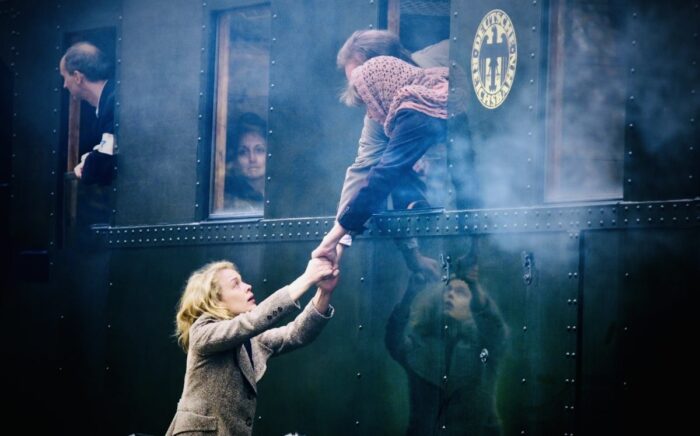
Stella, by now, has become notorious, having turned in hundreds of Jews in hiding in Berlin while enjoying the perks of her position as a turncoat.
The film fast forwards to 1957. Stella is on trial for her activities during the war, but is acquitted because she already spent years in a Soviet prison from 1946 onward.
In post-war West Germany, Stella remarries several times, converts to Christianity, degenerates into an antisemite, and attempts suicide.
Stella, an unflattering portrait of a supreme opportunist, is a competently-crafted film about a time and place when evil and expediency were the currencies of the day.