
In her debut as a director, Scarlett Johansson delivers a generally absorbing movie about Holocaust memory, identity and grief.
Eleanor the Great stars June Squibb as Eleanor Morgenstein, a spry and feisty 94-year-old widow whose life is upended when Bessie Stern (Rita Zohar), her roommate and best friend, dies. Bessie’s passing compells her to leave Florida and live with her divorced daughter, Lisa (Jessica Hecht), and her adult son, Maxie (Will Price), in New York City.
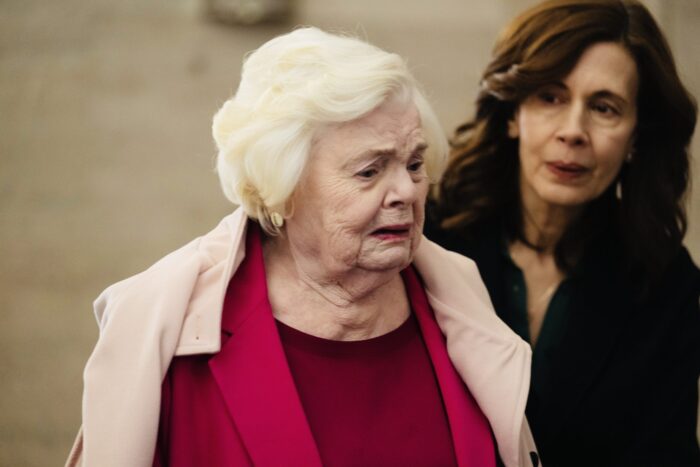
This sporadically moving film, which opens in theaters in Canada on September 26, focuses on Eleanor, who is both outspoken and demanding.
Eleanor’s distinctive characteristics emerge in an early scene when she helps Bessie, a Holocaust survivor from Poland, find a special jar of kosher pickles in a supermarket. The dim store employee claims that it is no longer in stock, but Eleanor, showing flashes of impatience, challenges him.
In terms of her Anglo appearance and waspish accent, Eleanor is the polar opposite of Bessie, a Yiddisher mama.
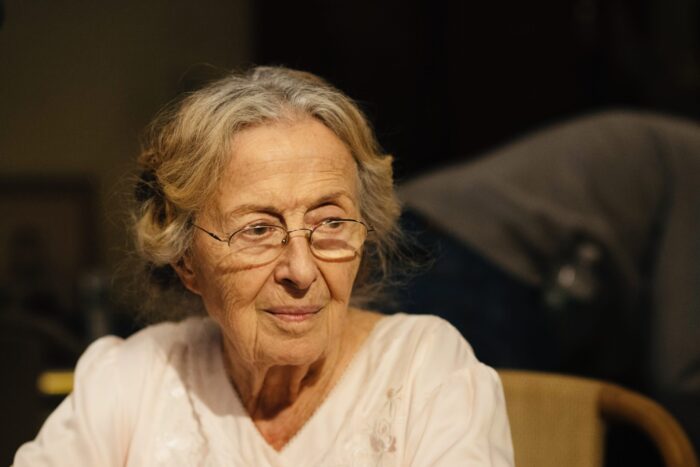
Disappointment greets Eleanor in New York City when Lisa suggests that she should live in a retirement home and Maxie fails to reciprocate her grandmotherly affection.
Joining a JCC (Jewish Community Center) group of Holocaust survivors, Eleanor tells them that she is originally from Poland and that she settled in the United States in 1953. As she speaks, Bessie’s harrowing story of survival in Nazi-occupied Poland fills the screen.
At this juncture, a new character, Nina Davis (Erin Kellyman), enters the picture. A biracial person, she studies journalism at New York University and is writing an article about the survivors.
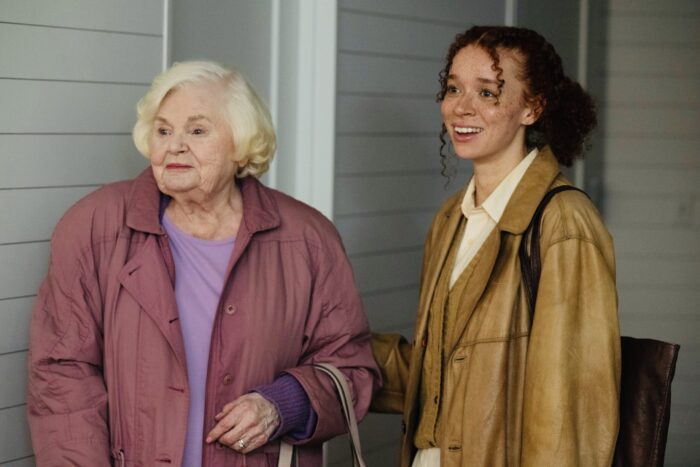
As they bond, Nina tells Eleanor she is still mourning the recent death of her mother. Increasingly drawn to Nina, Eleanor invites her to a Bat Mitzvah at a synagogue. In the next few scenes, they grow still closer, with Eleanor treating Nina a lot like a daughter or granddaughter. “You’re a cool lady, Eleanor,” says Nina.
Squibb, Zohar and Kellyman are convincing in their respective roles. Squibb’s performance is particularly noteworthy because she is actually 95.
Buoyed by the rapport she has established with Eleanor, Nina persuades her to address her classmates. As she begins speaking, an image of Bessie appears. A viewer might well wonder why Bessie is a surrogate for Eleanor as a Holocaust survivor.
Never having had the opportunity to “celebrate” her Jewish identity, Eleanor decides to have a Bat Mitzvah after chatting with a rabbi.
The film takes a turn when Nina’s estranged African-American father, Roger (Chiwetel Ejiofor), expresses an interest in meeting Eleanor. The host of a popular television program, he thinks that a profile about Eleanor would be appealing.
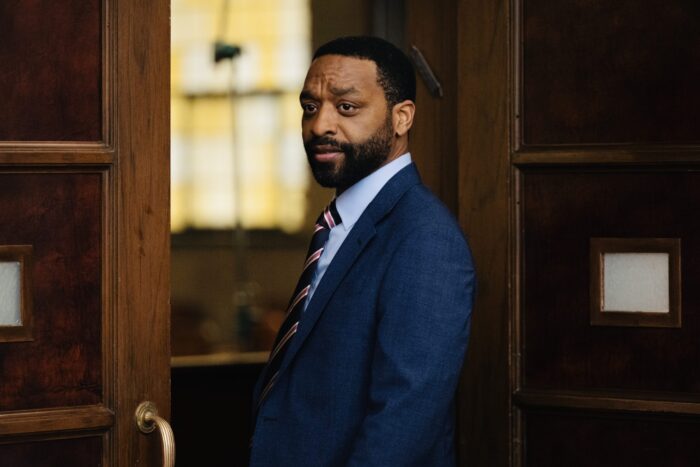
At this point, Eleanor’s identity is called into question, discombobulating her, upsetting Nina, and emboldening Roger to revise the video. The new version explores grief on a very personal level.
Thanks to a strong screenplay, superior performances, and Johansson’ able direction, Eleanor the Great acquits itself as a movie that addresses racial persecution, ethnic displacement and Holocaust trauma.