
Donald Trump’s ambitious 20-point peace plan to end the nearly two-year-old war in the Gaza Strip is broadly in line with Israel’s interests and brings Hamas one step closer to defeat on the battlefield.
Prime Minister Benjamin Netanyahu has endorsed the proposal, which, he acknowledged, “achieves our war aims.”
Hamas is reviewing the plan, but considers it unacceptable. In all probability, Hamas may rebuff Trump’s initiative, which resembles proposals presented by Egypt last February and by France and Saudi Arabia this past July. The expectation is that Hamas will either reject it outright or demand endless revisions.
The plan, partially crafted by former British prime minister Tony Blair, was refined by Trump’s special envoy to the Middle East, Steve Witkoff, and by his son-in-law and former senior adviser, Jared Kushner.
Witcoff and Kushner conferred with Netanyahu in a two-hour meeting on September 28 to review the details. Following their talks, Netanyahu said, “I hope we can make it a go, because we want to free our hostages, we want to get rid of Hamas rule, and have them disarmed, Gaza demilitarized, and a new future set up for Gazans and Israelis alike.”

Trump exuded confidence as well. “The Arab world wants peace, Israel wants peace and Bibi wants peace,” he said, using Netanyahu’s nickname. “If we get this done, it will be a great day for Israel and for the Middle East.”
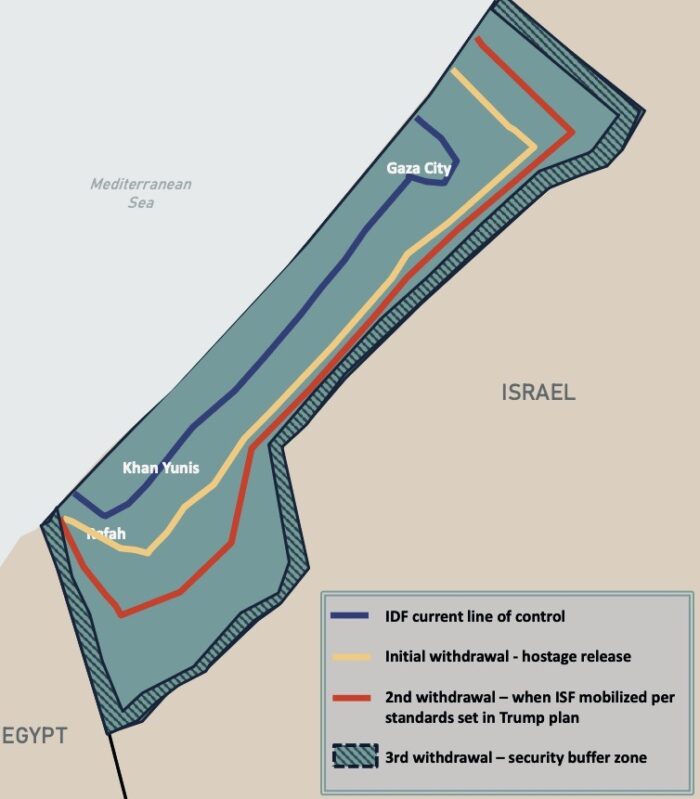
Under the provisions of the plan, the war will end immediately should it be accepted by both parties. Israeli forces would then withdraw to an agreed-upon line to prepare for the release of hostages and Palestinian prisoners within 72 hours.
During this period, Israel would cease all military operations currently under way in Gaza, and battle lines would remain frozen until conditions are ripe for a staged Israeli withdrawal from Gaza.
Although the plan was welcomed by the foreign ministers of major Arab and Muslim states, it basically converges with the principles laid down by the Israeli cabinet last month: Hamas’ disarmament, the return of all the remaining hostages, the demilitarization of Gaza, Israeli security control over Gaza for the foreseeable future, and the formation of a transitional government of Palestinian technocrats in which neither Hamas nor the Palestinian Authority would play a role.
At his joint press conference with Trump at the White House, Netanyahu warned Hamas that Israel would press on with its military campaign in Gaza should it spurn the plan or try to sabotage it.

Addressing Trump, Netanyahu said, “We’re giving everybody a chance to have this done peacefully … But if Hamas rejects your plan, or if they supposedly accept it and then basically do everything to counter it, then Israel will finish the job by itself. We didn’t fight this horrible fight, sacrifice the finest of our young men, to have Hamas stay in Gaza and threaten us again and again and again with these horrific massacres.”
In a demonstrable show of support, Trump told Netanyahu that he would grant Israel his “full backing” to destroy Hamas should it fail to cooperate. In that case, he added, the United States would allow Israel to “do what you would have to do.”

On September 30, Trump gave Hamas a “three or four days” deadline to come on board.
Hamas, which initiated the war by attacking Israel on October 7, 2023, finds itself between the hammer and the anvil.
If Hamas accepts Trump’s plan, its days as the paramount power in Gaza would be over. If Hamas displays recalcitrance, Israel will escalate its offensive in Gaza, which has caused the deaths of some 65,000 Palestinians and resulted in the levelling of much of its urban landscape.
Given these variables, Hamas has never been as weak and as isolated as it is now. Its weakness was amplified when several major Muslim countries — Saudi Arabia, Qatar, Egypt, Jordan, the United Arab Emirates, Indonesia and Pakistan — and the Palestinian Authority issued statements welcoming the plan.
Nonetheless, they issued a caveat, insisting on a “full Israeli withdrawal” from Gaza and the establishment of “a just peace on the basis of the two-state solution, under which Gaza is fully integrated with the West Bank in a Palestinian state.”
Although Trump’s initiative works to Israel’s advantage, Netanyahu’s far-right coalition partner, Finance Minister Bezalel Smotrich, dismissed it as a “resounding diplomatic failure.”
Smotrich’s dismissive attitude was hardly surprising in light of his stated desire to annex and resettle Gaza, from which Israel unilaterally withdrew in 2005, and to encourage Gazans to leave on a “voluntary” basis.
Under Trump’s plan, however, Palestinians would be encouraged to stay to build “a better” Gaza. “No one will be forced to leave, and those who wish to leave will be free … to return.”
This clause spells finis to Trump’s pie-in the-sky suggestion, enunciated last winter, that Gazans should emigrate so that the U.S. can claim ownership of Gaza and transform it into the “Riviera” of the Middle East.
Smotrich was also critical because it precludes Israel from occupying or annexing Gaza and calls for Israel’s gradual withdrawal. In this connection, he demanded that Israeli forces must continue to maintain a buffer zone around Gaza, retain possession of the Philadelphi Corridor along the Gaza-Egyptian border, and enjoy complete freedom of action to deal with all future threats.
In fact, Netanyahu agrees with these demands.
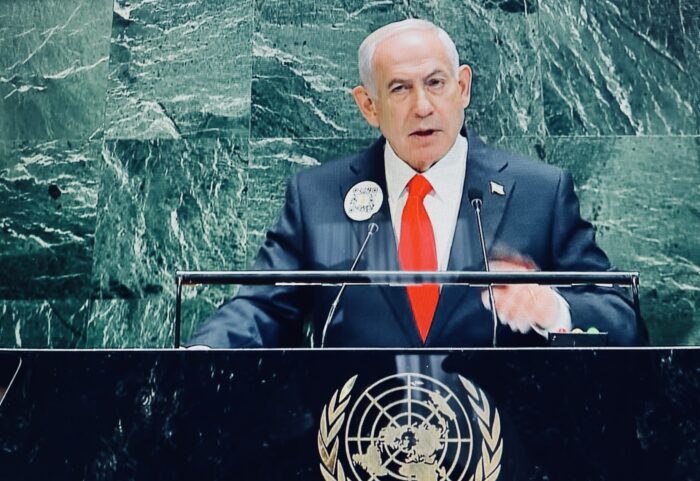
Trump’s proposal calls for a phased Israeli pullout from Gaza, but in his recent speech at the United Nations General Assembly, Netanyahu said that Israel will retain indefinite security control of Gaza. How these contradictory positions can be reconciled has yet to be determined.
Much to the Palestinians’ disappointment, the plan is vague regarding a potential pathway to Palestinian statehood and a possible role for the Palestinian Authority, both of which scenarios Netanyahu staunchly opposes.
“Giving the Palestinians a state one mile from Jerusalem after October 7 is like giving Al-Qaeda a state one mile from New York City after September 11,” he said at the United Nations last week. “This is sheer madness. It’s insane, and we won’t do it.”
To Netanyahu’s satisfaction, the plan is murky with respect to these interrelated issues. It states: “While Gaza redevelopment advances and when the Palestinian Authority reform program is faithfully carried out, the conditions may finally be in place for a credible pathway to Palestinian self-determination and statehood, which we recognize as the aspiration of the Palestinian people.”
Although Netanyahu has consistently rejected a role for the Palestinian Authority in governing postwar Gaza, Trump is not averse to the idea.
As he put it recently, “There are many Palestinians who wish to live in peace … and I challenge the Palestinians to take responsibility for their destiny … If the Palestinian Authority does not complete the reforms that I laid out in my vision for peace in 2020, they will have only themselves to blame.”
Trump, in 2020, envisioned new elections in the Palestinian Authority, the strengthening of independent judicial institutions, and the rejection of terrorism.
At their most recent press conference at the White House, neither Trump nor Netanyahu mentioned the apology that Netanyahu conveyed to Qatar concerning Israel’s unsuccessful air strike in Doha on September 9 aimed at killing Hamas’ chief hostage negotiators.
Nor did they discuss a topic much in the news these days, the prospect of an Israeli annexation of the West Bank. A few days ago, Trump poured cold water on it. “I will not allow Israel to annex the West Bank,” he said. “I will not allow it. It’s not going to happen.”
On the eve of Netanyahu’s visit to the White House, his fourth since January, Smotrich reiterated his hardline view that “Judea and Samaria are an inseparable part of the sovereign state of Israel.” Netanyahu concurs with that formula.
While it is still unclear whether Trump’s plan will fly, it is obvious that Israel’s standing in the United States has never been lower than it is now, judging by a New York Times survey released two days ago.
Immediately after the October 7 attack, 47 percent of respondents supported Israel, compared to 20 percent who backed the Palestinians. Today, 35 percent support the Palestinians, while 34 percent back Israel. The remainder said they did not know or favored neither side.
Israel’s battered image in the United States was the subject of a letter that the late conservative activist Charlie Kirk wrote to Netanyahu four months before his assassination. Kirk warned that Israel’s support among “Make America Great Again” Republicans was eroding due to its conduct of the war and the dire humanitarian situation in Gaza. In his letter, published by the New York Post, Kirk wrote, “In my opinion, Israel is losing the information war and needs a ‘communications intervention.’”
Trump’s peace plan, should it be implemented in full, may well assist Israel in its public relations battle in the United States.