The summer Olympic Games in Munich in 1972 presented West Germany with a golden opportunity to welcome visitors to the “new” Germany. A quarter of a century after the fall of Adolf Hitler’s genocidal Nazi regime, which persecuted and murdered German and European Jews before and during the Holocaust, Germans could finally try to put this horrific and shameful era behind them.
To their acute shock and embarrassment, this was not to be.
While Mark Spitz, an American Jewish swimmer, won a record number of seven gold medals, his achievement was grimly overshadowed by an explosive event that implicitly linked Germany, yet again, to the cold-blooded murder of Jews.
It happened when Palestinians from the Black September terrorist organization invaded the Olympic Village, broke into the apartments of Israeli athletes, and demanded the release of some 200 Palestinian prisoners in Israel.
The ensuing hostage crisis degenerated into an international drama, disrupting and marring the twentieth summer Olympics, the first to be televised live. It would also be the first terrorist attack to be broadcast around the world, riveting an audience of 900 million.
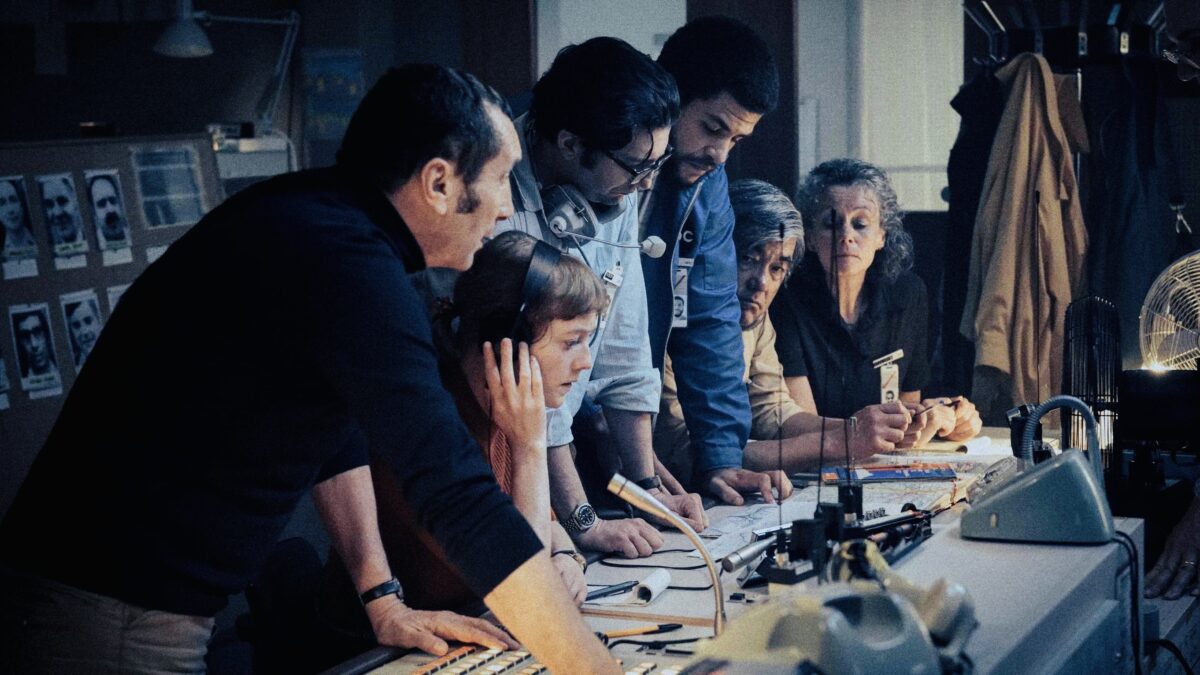
September 5, a feature film directed by Jim Fehlbaum and now available on Netflix, approaches this incident from the perspective of the ABC TV crew that covered it.
Its lead characters are Roone Arledge (Peter Sarsgaard), the director of ABC’s sports department; Geoffrey Mason (John Magaro), a producer; Peter Jennings (Benjamin Walker), a foreign correspondent, and Marianne Gebhardt (Leonie Benesch), a German-to-English translator. With the exception of Walker, they turn in stellar performances.

The film is uncompromisingly accurate in terms of its chronology and background footage, culled from ABC archives. Apart from a brief reference to Germany’s Nazi interregnum, it focuses exclusively on the events at hand and refrains from venturing into Israel’s complex conflict with the Palestinians. This is a wise choice, as it enables Fehlbaum to concentrate on the here and now.
Consistently taut and suspenseful, September 5 largely takes place in ABC’s control room, where a group of mostly dishevelled, overworked and tired producers and technicians hunch over darkened consoles, far from the outdoor sunny venues where the athletes compete.
Once it has been established that the terrorist attack has supplanted the Olympics as the real story, Arledge and his associates must determine whether to relinquish coverage to the news department and thereby render themselves superfluous. After a moment of reflection, Arledge reaches a firm decision. “This is our story and we’re keeping it,” he says. “We follow the story wherever it takes us.”
Since the narrative unfolds from ABC’s vantage point, the terrorists and their hostages are seen only fleetingly, mainly in brief scenes and photographs.
The tension escalates when Arledge discovers, much to his annoyance, that ABC must share the same satellite slot as its CBS competitor.

As the crisis deepens, the German government suspends the Olympics, but a volleyball game in progress is allowed to proceed.
The film is critical of the performance of the local police force, which was insufficiently vigilant. The terrorists surmounted a high fence to enter the Olympic Village, yet the police were nowhere in sight when this breach occurred.
On the other hand, Interior Minister Hans Dietrich Genscher is given credit for offering to swap himself in exchange for the hostages’ freedom.
The film gains a new spurt of energy when the terrorists demand to be flown out of West Germany with their hostages. With rumors abounding that they have been released, the ABC crew expresses elation, while a German government official voices relief.
The aura of optimism is shattered when the ugly truth emerges that the hostages have been killed in a shootout at the airport. The somber music that accompanies this letdown enhances the pain and disappointment.
Marianne, ABC’s only German employee on the premises, is positively downcast when she hears the terrible news. “Innocent people died in Germany again,” she says, speaking for some of her fellow Germans. “Germany failed.”
The deaths of Jewish athletes on German soil was an unforgettable tragedy of enormous proportions. Its impact is keenly felt in September 5, which neither sensationalizes nor downplays its historic significance.