
By any yardstick, Narendra Modi’s most recent visit to Israel, his second in nine years, seems to have been an unqualified success.
The prime minister of India, the world’s most populous democracy, spent two days in Israel, one of the few democracies in the Middle East.
He conferred with Prime Minister Benjamin Netanyahu and his ministers, delivered a rousing speech in the Knesset, and signed more than a dozen agreements in various fields.
He left Israel shortly before the Israeli and U.S. armed forces launched a coordinated attack against Iran.
Prior to Modi’s departure, Israel and India released a joint statement affirming their “special strategic partnership” in a wide range of areas ranging from defence and security to investment and technology.
Israeli officials framed the visit as an opportunity to expand Israel’s growing relationship with India, whose small Jewish community has never been oppressed by state antisemitism, and to work toward a free trade accord.
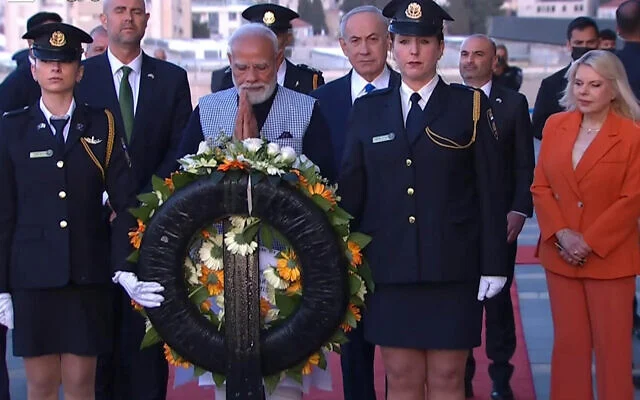
“The future belongs to those who innovate, and Israel and India are bent on innovation,” Netanyahu said. Modi called Israel “a powerhouse of innovation and technological leadership,” which, he noted, forms “a natural basis for a future-oriented partnership.”
Tellingly, Modi did not revisit Ramallah, the capital of the Palestinian Authority, despite India’s history of supporting the Palestinian cause.
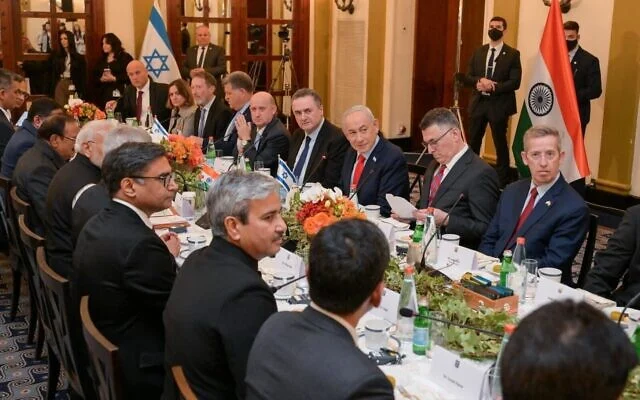
In comments before his arrival in Israel on February 25, Modi said, “India and Israel share a robust and multifaceted strategic partnership that has witnessed remarkable growth and dynamism in recent years.”
In his speech to the Knesset, Modi said that India stood “firmly” with Israel following Hamas’ attack on October 7, 2023.
“I carry with me the deepest condolences of the people of India for every life lost and for every family whose world was shattered in the barbaric terrorist attack by Hamas on October 7. We feel your pain, we share your grief. India stands with Israel firmly with full conviction in this moment and beyond.”
Describing himself as “a representative of one ancient civilization addressing another,” he said, “We are both ancient civilizations, and it is perhaps no surprise that our civilizational traditions also reveal philosophical parallels,” said Modi, a Hindu nationalist who has been prime minister since 2014.
“In India, there is great admiration for Israel’s resolve, courage and achievements,” he went on to say. “Long before we related to each other as modern states, we were linked by ties that go back more than 2,000 years.”
“After all, I was born on the same day that India formally recognized Israel — September 17, 1950,” he said.
Modi concluded his speech by invoking national rallying cries — “Am Yisrael Chai” (“The people of Israel live”) and “Jai Hind” (“Long live India”), drawing rounds of applause and chants of “Modi! Modi!”
Netanyahu, in his remarks in the Knesset, glowingly describing Modi as a “brother.”
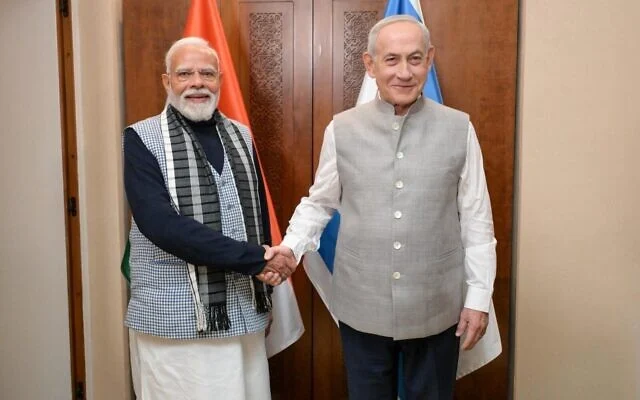
“Narendra, my dear friend, I am deeply, deeply moved by your visit here,” he said. “Because I have to be diplomatic, I will not rank it. I’ll get into trouble. But I’ve never been more moved than by your visit here with us, a great friend of Israel, a great champion of the Indian-Israeli alliance, and a great leader on the world stage.”
On the eve of Modi’s arrival in Israel, Netanyahu told reporters that his visit was part of an Israeli strategy to build alliances in Asia and Africa to counter Muslim radicalism.
“The fabric of this relationship has grown tighter,” Netanyahu said. “He is coming here so we can tighten it further through a series of decisions related to strengthening the cooperation between our governments and countries, including economic, diplomatic and security cooperation.”
Modi, in turn, tweeted, “Thank you, my friend, Prime Minister Netanyahu. I fully agree with you on the bond between India and Israel as well as the diverse nature of our bilateral relations.”
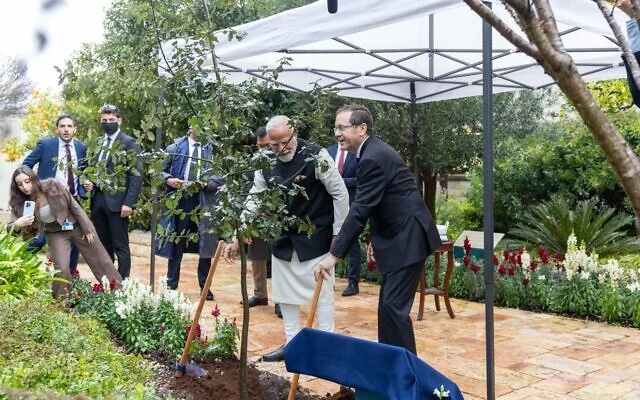
“India deeply values the enduring friendship with Israel, built on trust, innovation and a shared commitment to peace and progress,” he added. “I am confident that my state visit will further consolidate the enduring bonds between the two countries, set new goals for the strategic partnership, and advance our shared vision for a resilient, innovative and prosperous future.”
Modi visited Israel f0r the first time in the summer of 2017, the first Indian leader to set foot on Israeli soil. During his trip, he and Netanyahu waded barefoot into the Mediterranean Sea, with the surf gently lapping at their pants as they chatted. Netanyahu later presented Modi with an iconic photograph of their stroll on the beach.
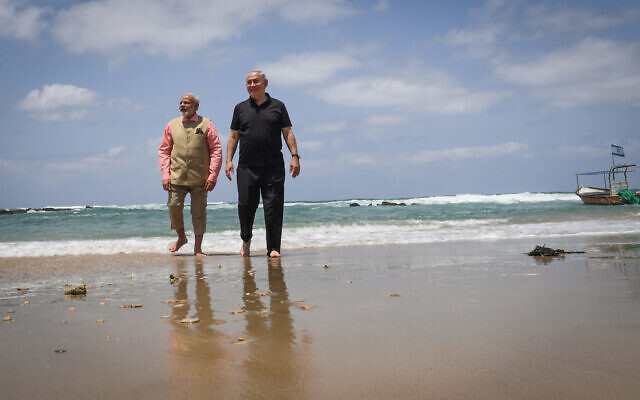
When he visited India a year later, Netanyahu praised Israel’s partnership with India as “a match made in heaven and consecrated on earth.”
Their joint visits were a breakthrough in the annals of Israel-India relations.
India formally recognized Israel two years after its creation as a Jewish state. Yet 42 years would elapse before India was politically ready to establish full diplomatic relations with Israel.
Until 1992, India was staunchly pro-Arab. The reasons are clear. India was a member of the generally anti-Israel non-alignment movement. India was dependent on Arab oil imports. India had to consider the pro-Palestinian sentiments of its substantial Muslim population.
India’s position, in part, was formed by Mahatma Gandhi, the Indian leader who was opposed to political Zionism and the creation of a Jewish state in Palestine at the expense of its Palestinian inhabitants. His view was rooted in his broader philosophy of anti-colonialism rather than in hostility toward Jews. “Palestine belongs to the Arabs in the same sense that England belongs to the English or France to the French,” he wrote.
Independent India under Jawaharlal Nehru and his successors, including Indira Gandhi, was decidedly cool toward Israel and friendly toward the Arab world.
India’s negative attitude toward Israel gradually crumbled under the weight of new geopolitical realities. Since Modi’s ascendancy as prime minister, India has significantly warmed toward Israel.
Modi’s India and Netanyahu’s Israel are like two peas in a pod. While Modi’s Bharatiya Janata Party seeks to transform India into a Hindu homeland for Hindus around the world, Netanyahu’s Likud Party regards Israel, including the West Bank, as the homeland of the Jewish people in the Diaspora.
Under Modi’s government, India’s bilateral relations with Israel have grown stronger, having led to cooperation in military and security affairs, agriculture, science, health, high tech and telecommunications.
Today, India is Israel’s second-largest trading partner in Asia after China, their volume of trade having reached $5 billion in 2024, with diamonds being a key component of it.
Israel has become the fourth largest supplier of weapons to India. Last July, the director general of the Ministry of Defence, Amir Baram, visited India to deepen cooperation with Indian arms manufacturers.

Last year, several Israeli ministers visited India, including Tourism Minister Haim Katz, Agriculture Minister Avi Dichter, Finance Minister Bezalel Smotrich and Economy Minister Nir Barkat.
By all accounts, Smotrich and Barkat were preparing the ground for a future free trade agreement, which could well revolutionize Israel’s burgeoning relations with India.