
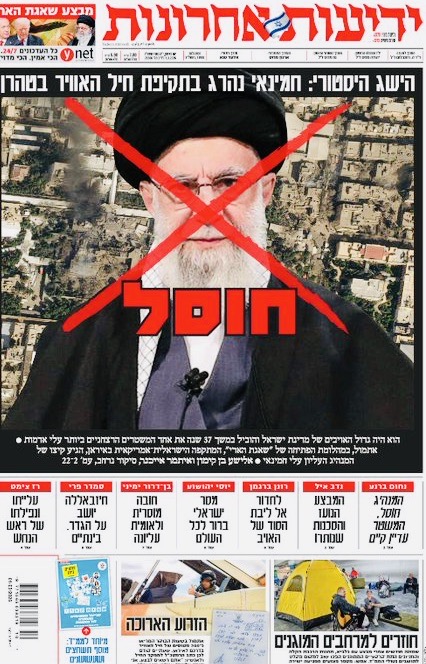
Until his assassination, Ayatollah Ali Khamenei, the supreme ruler of the Islamic Republic of Iran, was the longest-serving head of state in the Middle East. He was killed by Israel and the United States in a joint operation on February 28.
The air strike on his compound in Tehran took place shortly after U.S. President Donald Trump and Israeli Prime Minister Benjamin Netanyahu launched the second war in Iran in less than a year.
With Purim around the corner, Avigdor Liberman, the leader of the Yisrael Beytenu Party, compared Khamenei to the biblical figure Haman, an enemy of the Jewish people in their ancestral homeland.
Trump and Netanyahu ordered Khamenei’s killing after the third round of U.S.-Iran talks failed to resolve major differences over Iran’s nuclear program, its arsenal of ballistic missiles, and its support of regional proxies such as Hezbollah, Hamas and the Houthis.
Khamenei’s violent death, a defining and transformative moment in the U.S.’ and Israel’s long-running confrontation with Iran, shocked and enraged the Iranian regime.
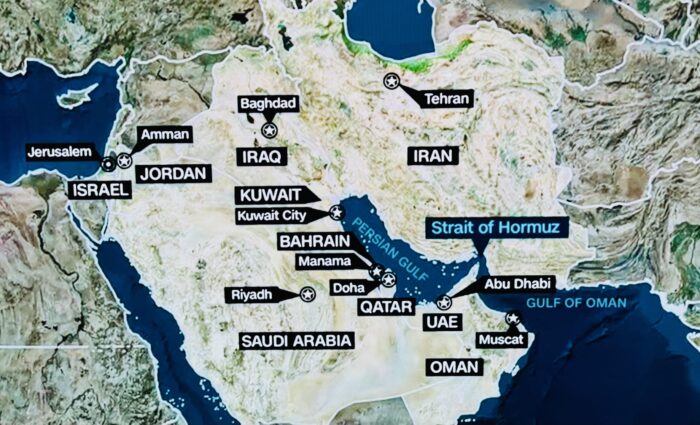
Promising harsh vengeance, Iran lashed out with retaliatory missile attacks that led to the deaths of nine Israelis in Beit Shemesh and six American servicemen in Kuwait and the bombardment of Beersheba.
Khamenei, 86, was the second major Iranian figure to be assassinated in the past few years. In January 2020, U.S. drones struck Qassem Soleimani, the commander of the Quds Force, the fighting arm of the Islamic Revolutionary Guards Corps, a pillar of the Iranian regime. Soleimani, a protege of Khamenei, was targeted on the fringes of Baghdad’s airport. He was instrumental in the formation and the management of the Axis of Resistance, an anti-Western alliance of surrogates whose role was to build a “ring of fire” around Israel and drive the United States out of its bases in the Arab world.
Four years later, as Israel fought a war with Hamas in the Gaza Strip, the Mossad, Israel’s external intelligence agency, assassinated top-ranking Hamas official Ismail Haniyeh in Tehran. Haniyeh was killed as Masoud Pezeshkian was to be inaugurated as Iran’s next president.
In the same year, Israel eliminated Hassan Nasrallah, the secretary-general of Hezbollah, and Yahyah Sinwar, the political leader of Hamas. They were were members of the Axis of Resistance, whose objective is the destruction of Israel.
Khamenei, whose lengthy tenure spanned the terms of six American presidents from George H.W. Bush to Trump, was an arch foe of the U.S. and Israel.
Regarding the United States as a “vindictive and malevolent” enemy, he applauded the seizure of the American embassy and its diplomatic staff in Tehran in 1979 as “a great and valuable service performed for our revolution.”
This event unfolded shortly after the fall of the pro-Western Iranian monarchy and the advent of the Islamic revolution. By then, Khamenei was only two years away from becoming Iran’s president. Ayatollah Ruhollah Khomeini, Iran’s first post-revolutionary supreme leader, died in 1989. Khamenei, who was president from 1981 until Khomeini’s death, succeeded him.
Khamenei’s pro-Palestinian inclinations deepened after reading the works of Sayyid Qutb, a virulently anti-Israel activist in the Muslim Brotherhood in Egypt.
Khamenei’s worldview was shaped by animosity toward Israel, which he described as “a cancerous tumor that must be removed,” and the United States, which he referred to as “the great satan.”
As the second supreme leader of the Islamic Republic, Khamenei consolidated its hard-line Islamist and anti-Western policies. He blocked efforts by moderates to phase in reforms, branding them as Western-orchestrated examples of “sedition.”
He crushed manifestations of dissent with arrests and executions, imprisoned critics and journalists who defied him, and enforced draconian restrictions on women. In pursuit of creating a police state, he expanded the Islamic Revolutionary Guards Corps, a powerful body of repression.
From 2009 onwards, Iran was faced by periodical nation-wide demonstrations, which were ruthlessly put down by security forces. Two months ago, he ordered them to open fire on protesters who took to the streets peacefully over economic issues.
The regime admitted that more than 3,100 people had been killed, but human rights organizations put the toll at least 7,000. Khamenei blamed foreign “enemies” for provoking the bloodshed, a claim that was never substantiated.
Khamenei had a decisive say in foreign policy.
The 2003 U.S.-led invasion of neighboring Iraq, a Shi’a-majority country, emboldened him to extend Iran’s influence beyond its borders. With the toppling of Saddam Hussein’s Sunni regime, the Iranian government funnelled funds to Shi’a political parties and armed and trained Shi’a militias, giving Iran significant clout in Iraqi politics.
In 2014, Iran and the United States temporarily found themselves on the same side after Islamic State, a Sunni jihadist group, captured a large chunk of territory in Iraq.
With the 2011 Arab Spring uprising in Syria, Khamenei dispatched Iranian military advisors and Shi’a militias to Syria in support of President Bashar al-Assad ‘s attempt to quell the civil war.
Iran established bases in Syria and tried to use the Syrian side of the Golan Heights as a platform from which to harass and attack Israel. These provocations prompted Israel to regularly bomb Iranian and Syrian military positions from 2013 onward.
Israel’s bombing of Iran’s consulate in Damascus in the spring of 2024 triggered two major clashes. In April and October, Iran fired drones and missiles at Israel, prompting Israel to reply with air raids in Iran.
Sunni rebels, backed by Turkey, ousted Assad’s totalitarian regime in December 2024, forcing Iran to withdraw its forces from Syria. Iran’s ignominious retreat resulted in its loss of influence in Syria. It was a bitter blow that significantly reduced Iran’s profile in the Middle East.
Iran suffered two more stunning setbacks in that year.
Hamas and Islamic Jihad, Iran’s surrogates in Gaza, were battered by Israel in what would be a two-year war. Khamenei praised Hamas’ October 7 attack that triggered the war. Hezbollah, Iran’s greatest regional proxy, was thrashed by Israel during its invasion of southern Lebanon.
Much to the distress and anger of Israel and the United States, Khamenei made uranium enrichment and ballistic missile development key elements of his effort to cement Iran’s status as a regional power.
Despite his deep suspicion of the West, he agreed to sign a nuclear deal in 2015 that restricted Iran’s right to enrich uranium beyond three percent in exchange for the lifting of international sanctions. Trump, in his first term, pulled out of the agreement, restored sanctions and imposed new ones.
Toward the end of his life, countless Iranians perceived Khamenei as a ruthless dictator who presided over a repressive, heartless and corrupt regime whose policies led to the deaths of thousands of Iranians and compelled countless others into exile.
To the United States and its Western allies, Khamenei’s Iran was seen as a destabilizing force, a threat to the regional order and a sponsor of terrorism.
To Israel, he was a demon who sought its eradication.
Trump openly welcomed his assassination. On his social media site, he described Khamenei as “one of the most evil people in history.”
Khamenei was killed after the U.S. Central Intelligence Agency learned that he would attend a Saturday morning meeting of senior Iranian officials at his compound in central Tehran. The CIA had been tracking his movements for months.
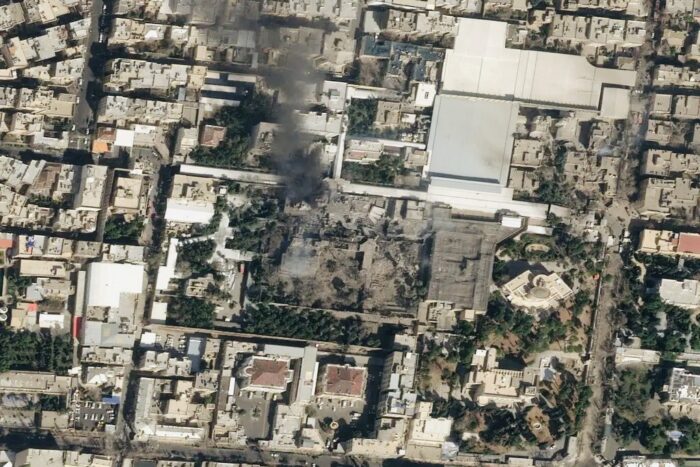
The Israeli Air Force was tasked with the mission of bombing his compound after the U.S. struck it with Tomahawk missiles. The strikes also killed Khamenei’s daughter, grandchild, daughter-in-law and son-in-law, as well as Iranian defence officials.
They included Abdolrahim Mousavi, the commander of Iran’s armed force; Mohammad Pakpour, the commander-in-chief of the Islamic Revolutionary Guards Corps; Seyyed Majid Mousavi, the commander of the Islamic Revolutionary Guards Corps Aerospace Force; Aziz Nasirzadeh, the minister of defence; Ali Shamkhani, the head of the Military Council, and Mohammad Shirazi, the deputy intelligence minister.
In the aftermath of Khamenei’s death, Ayatollah Alireza Arafi temporarily replaced him until a successor is chosen.
Pezeshkian, Iran’s president, has denounced Khamenei’s assassination as an “open declaration of war against Muslims.” He said that Iran will “firmly continue” on Khamenei’s path.
If that proves to be true, Iran will condemn itself and its people to yet more pain and suffering.