
Under cover of Israel’s wars in the Gaza Strip, Lebanon and Iran since 2023, the Israeli government has consolidated its control of the West Bank immeasurably.
Existing settlements have been expanded. New ones have been built. Unauthorized outposts have been legalized. Evacuated settlements have been reestablished.
Prime Minister Benjamin Netanyahu’s right-wing coalition government, which assumed office in December 2022, has increased settlement funding and pledged to advance policies to ensure that much of the West Bank remains in Israel’s hands, according to Chatham House, an independent policy think tank in Britain otherwise known as the Royal Institute of International Affairs.
The Israeli government, however, has not formally annexed the West Bank, which has been occupied by Israel since the 1967 Six Day War.
In the latest developments, which were announced on April 9 and April 19, Israel’s security cabinet decided to establish 34 new settlements, while government ministers celebrated the resurrection of Sa-Nur, a settlement in the northern West Bank that was closed in 2005 when Israel unilaterally withdrew from the Gaza Strip.

Of the 34 settlements, some will be built from scratch and still others will be retroactively legalized. They will be located in Area C, which comprises about 60 percent of the West Bank and is fully under Israel’s occupation.
The Palestinian Authority, which is based in the West Bank city of Ramallah, controls Area A and part of Area B.
Since returning to office, Netanyahu has green lighted the establishment of 103 settlements. By comparison, six new ones were constructed between 1993 and 2022.
There are currently a total of 144 settlements in the West Bank. If all of the 103 settlements are ultimately built, the figure would grow to 235.
Peace Now, an Israeli organization that closely monitors the construction and expansion of settlements, claims that Netanyahu is attempting to establish as many “facts on the ground” as possible before the next general election, which is scheduled to take place in October.
The announcements concerning new settlements should be seen within the framework of a plan initiated by Yossi Dagan, the chairman of the Samaria Regional Council, to settle one million Israelis in the northern West Bank by 2050. At present, 49,000 live there.
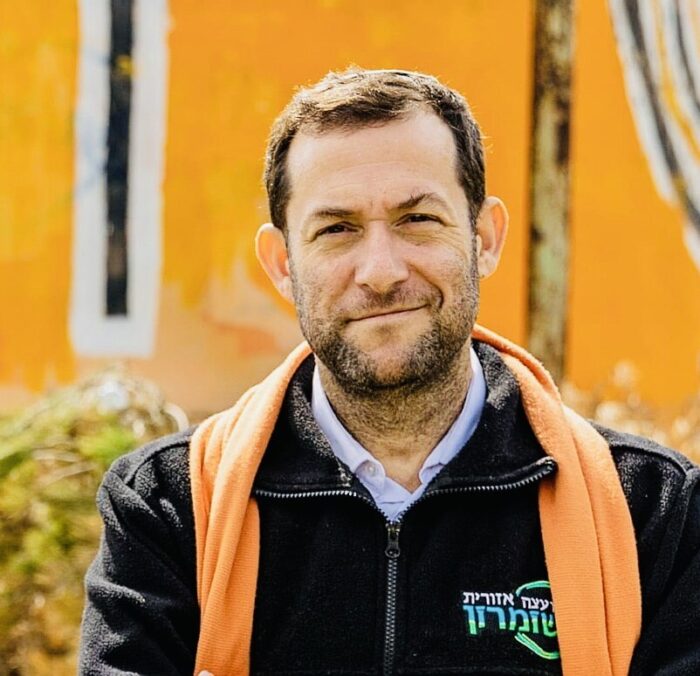
“This is a historic decision,” Energy Minister Yossi Cohen said. And in a reference to the government’s intention to keep the West Bank, he said, “We are applying sovereignty in law and in practice.”
Dagan, who was evacuated from his home in Sa-Nur in 2005, made a similar point: “We will fill the area with roads, electricity, water and sewage infrastructure in order to bring the masses here.”
Speaking at the reestablishment of Sa-Nur, Finance Minister Bezalel Smotrich hailed it as a “national holiday” and a “historic correction.” He declared, “We are abolishing the disgrace of expulsion, killing the idea of a Palestinian state. This is a day of celebration for the settlement movement.”
Netanyahu’s government paved the way for Sa-Nur’s resurrection in March 2023, when it repealed legislation that had prohibited Israelis from living there and in three other settlements in the northern West Bank.
This occurred seven months before several thousand heavily-armed Hamas terrorists attacked towns, kibbutzim and army bases in southern Israel in an unprecedented invasion that resulted in the deaths of roughly 1,200 people and the kidnapping of 251 Israelis and foreigners.
Last May, Israel’s security cabinet approved the establishment of 22 new settlements, including Sa-Nur, in the West Bank. It was the largest expansion of settlements in decades. In July, the Knesset, in a symbolic non-binding resolution, voted to “apply Israeli sovereignty” in the West Bank.
In the same year, Israel went ahead with the E1 settlement project near Jerusalem. Covering around 3 percent of the West Bank, it breaks its territorial continuity, isolating Palestinian cities such as Bethlehem and Ramallah, and undermines the viability of Palestinian statehood.
As Smotrich put it, E1 is intended to “bury” the notion of a sovereign and contiguous Palestinian state.
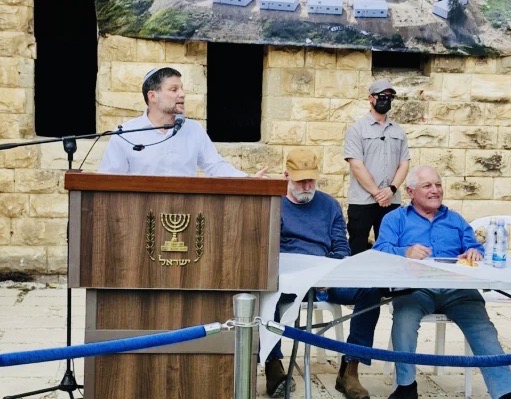
Smotrich’s opposition to Palestinian statehood is contained in his ‘One Hope’ plan. It is squarely aimed at eradicating the idea of a two-state solution, which is supported by virtually every member state of the United Nations.
It is worth reading excerpts from his plan to better understand what drives him and his colleagues in the Israeli government.
As he writes, “The ‘two-state’ model has led Israel to a dead end … The alternative to this is a new readiness of Israeli society to win the conflict, rather than merely managing it — a victory founded on the understanding that there is no room in the Land of Israel for two conflicting national movements.
“The two-state solution is not realistic and never was. ‘Two-states for two peoples’ is a slogan empty of content that has become the axiomatic solution for the conflict primarily because of the illusion that the Arab side is open to territorial compromise and willing to accept the State of Israel as a Jewish state. This assumption has been repeatedly proven false.
“Under the present reality, the establishment of an Arab terror state in Judea and Samaria, a state whose territory is twenty times larger than the Hamas terror state in the Gaza Strip, would be nothing less than suicidal from the security perspective … The two-state solution is unfeasible, and it is therefore time to put a solution, based on an entirely different approach, on the table.
“The continued existence of the two conflicting national aspirations in our small piece of territory will ensure many more years of bloodshed and armed conflict. Only when one of the sides concedes, willingly or by force, and forgoes its national aspirations in the Land of Israel, will the desired peace come about and civilian coexistence becomes possible.”
In his view, Palestinians, or the “Arabs of the Land of Israel,” can either “forgo their national aspirations and stay here and live as individuals in the Jewish state,” or they can pack their bags and leave.
“Those who choose not to let go of their national ambitions will receive aid to emigrate to one of the many countries where Arabs realize their national ambitions, or to any other destination in the world.
“It is, of course, safe to assume that not everyone will adopt one of these two choices. There will be those who will continue to fight the Israel Defence Forces, the State of Israel, and the Jewish population. Such terrorists will be dealt with by the security forces with a strong hand …”
Smotrich’s manifesto, a window inside the far right in Israel, has been adopted by the current Israeli government, which has no real interest in reaching a peace agreement with the present Palestinian leadership in the Palestinian Authority.
Political figures like Smotrich and Netanyahu would rather keep land in the West Bank — the ancestral homeland of the Jewish people — than exchange it for what could be a pragmatic accommodation with the Palestinians.
Which is why Netanyahu has accelerated the expansion of West Bank settlements. To him and like-minded Israelis who subscribe to the tenets of Revisionist Zionism, settlements establish the parameters of new borders and create an iron wall of security.
Yet settlements are and have been sowing further anger and embitterment among Palestinians, intensifying the protracted conflict between Zionism and Palestinian nationalism, and precluding the possibility of peace.