
China has condemned the United States’ and Israel’s joint military offensive in Iran and has called for an immediate ceasefire. As the largest buyer of Iranian oil, China provides Iran with critical economic support.
At the same time, China seeks to maintain a stable relationship with Israel.
In the past few years, however, antisemitic tropes have creeped into Chinese state media and on social media platforms, upending China’s benevolent image among Jews. Until now, China was one of the very few countries without a history of indigenous antisemitism.
Much of the anti-Jewish animus comes from nationalist intellectuals and online opinion leaders, says Meng Yang, a Chinese academic. An assistant professor at Peking University in Beijing, she teaches China’s first and only university-level Yiddish course and delivers lectures on Jewish civilization, the Holocaust and contemporary antisemitism.
Yang told the Jewish News of Northern California recently that antisemitism is not necessarily generated by the state. “Some say that antisemitism in China must come from the government. But from my teaching experience and student feedback, I see that much of the hostility actually comes from nationalist intellectuals and online opinion leaders.”

“Conspiracy theories about Jews, including versions of blood libel, circulate widely,” she added. “Because China has a very small Jewish population and because Judaism is not among the five officially recognized religions in China, most people’s perceptions come from the internet rather than personal contact. That makes misinformation harder to counter.”
According to a thoroughly-researched and sober report written by Shalom Salomon Wald for The Jewish People Policy Institute, antisemitism in China has developed without “a historical background of Jewish persecution and without a significant Jewish presence in the country — a fact that makes the phenomenon particularly unique and troubling.”
This trend is driven by several strategic geopolitical shifts: China’s escalating rivalry with the United States, where Jews are perceived as playing a leading role in the economy, media and politics. China’s growing alignment with Arab and Muslim-majority nations such as Iran, Israel’s deadliest enemy. The pull of global antisemitism, which has grown significantly since Hamas’ one day invasion of southern Israel on October 7, 2023 and the subsequent Israel-Hamas war in the Gaza Strip.
In fact, the first antisemitic wave that washed over China’s social and official media landscape occurred during the 2021 Gaza war. It was authorized, if not initiated, by the Chinese government and based on anti-Jewish tropes conflating Israel, Jews, and Judaism, the report claims.
In 2024, the Anti-Defamation League carried out nation-wide opinion polls in many countries, including China, and published a global antisemitism index. The ADL website claims that 660 million Chinese people, or 47 percent of China’s population, “harbor elevated levels of antisemitic attitudes.”
Universities and social media platforms used by Marxist and nationalist pundits and influencers are the leading incubators of antisemitism. They could well “prejudice the minds of students, China’s future leaders, and extinguish the interest in Jews and Israel that once existed among parts of China’s reading public.”
“The classical Chinese stereotypes of the Jews emphasized traditional Western values and achievements, which many Chinese admired,” the report says. “When China’s views of the West deteriorated and Israel was increasingly seen as a mere annex of the United States, philosemitism flipped into antisemitism.”
Today, mainland China is home to 2,500 to 3,500 Jews. Another 3,500 to 5,000 live in Hong Kong.
A small Jewish community, composed of traders from Persian and Afghanistan, flourished in Kaifeng, once the capital of the Song dynasty, from the 12th to the 19th century. Jews never faced discrimination and were totally assimilated into Chinese culture and society, as I learned during a trip to Kaifeng some years ago.
During the late 19th and early 20th centuries, Chinese political reformers who visited the West discovered that Chinese and Jews shared a common history of oppression.
At the same time, antisemitic stereotypes from the West infiltrated Chinese newspapers and intellectual discourse, but Jews inside China were not targeted. The main foreign transmitters of antisemitism were Christian missionaries and Chinese students returning from abroad, some of whom equated Jews with communism or plots to rule the world.
“A genuine Chinese understanding of Jewish history developed in the early 20th century. Sun Yat-sen, the first provisional president of the Republic of China, compared the tragic fate of the Jews to that of the Chinese.” A supporter of Zionism, he described it as a “movement to restore your wonderful and historic nation, which has contributed so much to the civilization of the world.”

During the late 1930s and early 1940s, more than 20,000 European Jews fleeing Nazi persecution were allowed into Shanghai. There were smaller Jewish communities in Harbin and Tianjin.
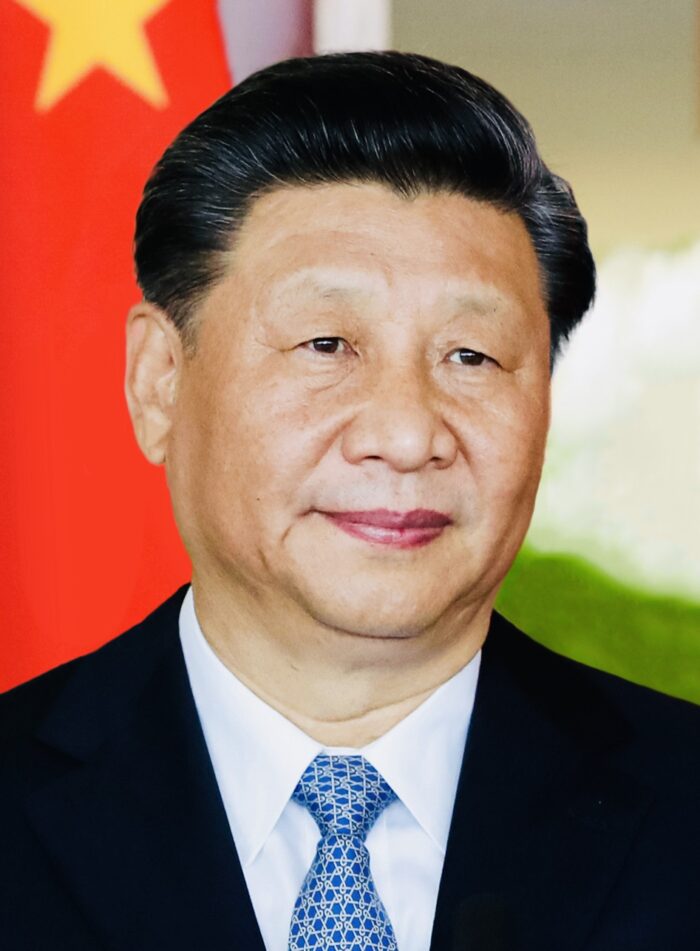
None of China’s top communist leaders from the early 1920s onward were known to be personally or ideologically antisemitic. Chinese President Xi Jinping’s few statements about Jews and Judaism suggest that he opposes antisemitism.
The Communist Party’s People’s Daily welcomed Israel’s establishment in 1948. But China eventually turned against Israel, portraying it as a colonialist white settler outpost that dispossessed the Palestinians.
Like the former Soviet Union, China conflates Israel with Jews. “Soviet hostility was directed at Israel, the United States, its allies, and the large Jewish community in the USSR suspected of supporting Israel. The new Chinese version also targets Israel and the United States but lacks a local Jewish minority as a focus. Instead, it targets American Jewry and aligns with the antisemitism and anti-Americanism of the Muslim world.
“This conflation often means that positive or negative relations with Israel translate into positive or negative relations with the Jews — not the few in China today, but the entirety of world Jewry.”
Israel established formal diplomatic relations with China in 1992, and their relationship flourished, especially in the realm of trade and technology. China is one of Israel’s most important mercantile partners, but its support of Palestinian statehood, its condemnation of Israel’s military campaign in Gaza, and its expanding strategic ties with Iran have caused problems.
“Around 2021, the Chinese government chose to harden its attitude towards Israel and its Jewish supporters,” the report states. “Whether Xi Jinping himself made the relevant decisions is not known. No single reason, but a convergence of events, caused this change.”
Certainly, China resented Israel’s compliance with the United States’ demand to limit China’s critical infrastructure investments in Israel.
An unprecedented “antisemitic media wave” started with the Gaza war in 2021, and was reinforced by Hamas’ attack on October 7. This incursion “greatly damaged Israel’s image” in China as a military power.
“Chinese media began spreading antisemitic tropes under the cover of criticism of Israel’s military actions. While similar denunciations conflating Israel, Zionists, and Jews occurred in other countries too, in China all political speech is tightly monitored and censored if it is not in line with official positions. If antisemitism was spreading on China’s media, it meant that it was officially sanctioned. It appeared in government sources and public media, in social media, and in universities.”
Since then, antisemitism has surged on media platforms controlled by the Chinese government. “The vice president of China’s Foreign Ministry think tank, China Institute for International Studies, alleged that ‘the foundation for political survival in the U.S. is parasitically attached to Israel’s powerful Jewish forces.’”
“Cyber nationalists and Marxists, internet pundits and influencers were free to defame Israel and Jews because the internet antisemites were protected by official approval.”
One of these bloggers, Lu Kewen, claims to have 15 million followers. He defames the Jews with quotes from Hitler’s Mein Kampf and the Protocols of the Elders of Zion.

Another media influencer, Su Lin, stated that “Hamas went too soft on Israel.”
The financier George Soros is a “preferred target” of China’s internet bloggers. “Although Soros has no public Jewish connections and is funding organizations critical of Israel, his characteristics fulfill the criteria most relevant for Chinese polemicists: he is a Jew, very rich, American, politically influential, and an enemy of China. Hence, China’s internet antisemites accuse him of representing the Jews’ alleged international financial power and of conspiring to control the world for Jewish benefit.”
At universities, which are government-financed and therefore obliged to follow government directions, visitors report that some teaching staff and students openly express antisemitic views.
Xiao Zhiguang, a professor of international relations at Fudan University in Shanghai, is cited as an academic who spreads antisemitism. He is said to be closely aligned with Xi Jinping’s political and ideological agenda.
“Objective research and unbiased publications on Israel, Zionism or Judaism have become difficult, unpopular and in some cases impossible. Fewer academics teach and do research on Jewish culture and history than in the past.
“In 2024, China closed down the first Chinese university in Israel, a branch of Beijing’s University of International Business and Economics, after three years of operation. The Chinese professors and students returned home. The reasons were said to be practical and not antisemitic or anti-Israeli, but the closure still sent a message.”
China, however, has taken small diplomatic steps to improve its bilateral relations with Israel in the last year or so. Its ambassador to Israel, Xiao Junzheng, called for “a new chapter” in China- Israel ties. He also condemned the Hamas “atrocities” of October 7 as “inhuman” and “outrageous” and said that an Iranian nuclear weapon would be unacceptable to China.
His comments were not reported in China’s media.
The Jewish People Policy Institute recommends that Israel should “preserve all possible links with China, but not accept China’s denial of media and university antisemitism.”
Israel, too, should maintain its “One China” policy while “strengthening non-political links with Taiwan and increasing research on the long history of Sino-Judaic relations.”
Clearly, Israel and China have a lot of work to do to revitalize their relationship.