
Germany’s suspension of arms sales to Israel marks a significant shift in its bilateral relations with the Jewish state. From this point forward, Germany will not sell weapons to Israel that can be used in its war against Hamas in the Gaza Strip.
Never before has Germany resorted to such a drastic tactic to express displeasure with Israel’s policy.
Chancellor Friedrich Merz made the announcement on August 8, the same day the Israeli government announced its intention to expand the war and capture Gaza City.
Prime Minister Benjamin Netanyahu denounced the move. “Instead of supporting Israel’s just war against Hamas, which carried out the most horrific attack against the Jewish people since the Holocaust, Germany is rewarding Hamas terrorism by embargoing arms to Israel,” he said in a sharp statement.
Merz’s announcement is certainly a bombshell. A few months ago, Foreign Minister Gideon Saar described Germany as “a friendly country … even when there are disagreements between us.”
Germany, given its persecution of German Jews during the Third Reich and its central role in the Holocaust, has had a special relationship with Israel since they established formal diplomatic relations on May 12, 1965. This marked the beginning of mutually beneficial but sometimes bumpy ties.

In referring to Israel’s decision to forge official relations with Germany (then West Germany), Israeli Prime Minister Levi Eshkol made an implicit reference to the Holocaust and expressed the hope that it “will prove to be an important step towards a better future.”
Since then, Germany has become Israel’s closest ally in Europe and certainly one of its best friends. Prior to his appointment as chancellor, Merz visited Israel and declared that “the existence and security of Israel are a part of German raison d’être.”
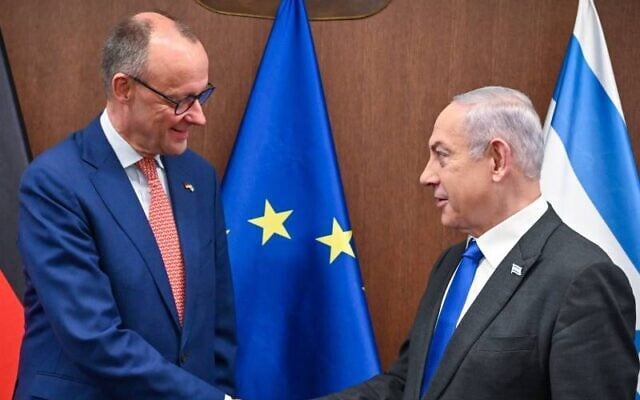
One of his predecessors, Angela Merkel, enunciated this principle in a historic speech to the Knesset, but it has been at the core of German statecraft for decades now.

Nonetheless, Israel’s image in Germany has been tarnished by the Israel-Hamas war and the humanitarian crisis it has spawned. A survey taken by the Bertelsmann Foundation in May found that only 36 percent of Germans viewed Israel positively, while 38 percent viewed it negatively.
Germany’s bilateral relations with Israel have been buffeted since the outbreak of the war. While publicly supportive of Israel, Merz has had several tense telephone conversations with Netanyahu, urging him to reach a ceasefire with Hamas and allowing more food and medical supplies into Gaza.
In announcing the suspension of weapons to Israel, Merz also accentuated the positive. He voiced support for Israel’s “right to defend itself against Hamas’ terror.” He asserted that Hamas cannot play a role in Gaza’s future. And he demanded the release of Israeli hostages held in Gaza.
But the central theme of his announcement revolved around the export of German weapons to Israel. As he put it, “The even harsher military action by the Israeli army in the Gaza Strip, approved last night by the Israeli security cabinet, makes it increasingly difficult, from the German government’s perspective, to see how these goals are to be achieved. Under these circumstances, the German government will not authorize any exports of military equipment that could be used in the Gaza Strip until further notice.”
He added that Israel must “comprehensively and sustainably improve the humanitarian situation in Gaza.”
Merz, the leader of the conservative Christian Democratic Union Party, banned new arms sales to Israel after coming under intense pressure from his left-of-center coalition partner, the Social Democratic Party, to act more resolutely on Gaza.
With reports of widespread malnutrition and starvation in Gaza, Merz found himself on the defensive. The tipping point, for him, occurred after Israel said it intended to intensify its military campaign in Gaza.
The Social Democrats called for limiting or stopping the delivery of new weapons to Israel. The Christian Social Union, Merz’s sister party in Bavaria, disagreed, calling for unqualified support of Israel and Netanyahu.
Merz came under further pressure last week, when some 200 German literary figures published an open letter calling for the halt of arms sales to Israel and a suspension of the European Union’s technology and culture agreement with Israel.
Three months ago, Merz criticized Israeli air strikes in Gaza, while Foreign Minister Johann Wadephul warned Israel that Germany was considering new steps.

“The massive military strikes by the Israelis in Gaza no longer reveal any logic to me,” said Merz.
Wadephul was just as blunt. “We are now at the point where we have to think very carefully about what future steps to take,” he said without elaborating. In retrospect, he was probably thinking of suspending arms sales to Israel.
It is far from clear what weapons the German government intends to withhold. But the Israeli armed forces may feel the suspension. Germany, after the United States, is the second-largest supplier of military equipment to Israel.
According to the Stockholm International Peace Research Institute, Germany currently supplies Israel with one-third of its weapons, which range from electronic equipment and armored vehicles to frigates and torpedoes.
From 2023 until this past May, Germany exported $565 million worth of arms to Israel, according to the German parliament.
In the past few months, several countries have stopped selling spare parts or weapons to Israel.
The Netherlands is no longer providing spare parts for Israel’s fleet of advanced F-35 jet fighters. Britain has suspended some arms-export licenses. Canada and Italy have cancelled new permits for arms exports to Israel. Last week, Slovenia announced it would ban the import and export of all weapons to and from Israel.
Due to the war in Gaza, the German government also faces pressure to recognize Palestinian statehood. In recent weeks, France, Britain and Canada, among others, have announced plans to extend recognition to a yet unformed Palestinian state.
Although Germany endorses a two-state solution, the current German government believes that Palestinian statehood should be the end product of negotiations between Israel and the Palestinians. Germany has urged Israel to begin talks toward that end, but Israel is not interested.