
Israel, sporadically over the years, has been the object of fierce and unrelenting international criticism, but the global opprobrium Israel is currently facing appears to be unprecedented.
Israel’s invasion of Lebanon in 1982 aroused widespread anger. The third cross-border war between Israel and Hamas in 2014 created an uproar that caused reputational harm to Israel. These wars gave Israel a black eye in terms of optics, but they pale in comparison to what is happening today.
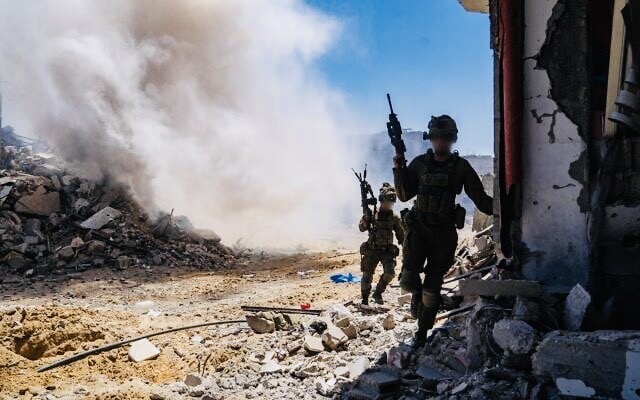
The ongoing war in the Gaza Strip, with its images of urban destruction and intimations of starvation and famine, have placed Israel in a very uncomfortable position from a public relations point of view.
Even allies like Canada, Britain and France have called for an immediate ceasefire and condemned Israel’s handling of the humanitarian crisis there. And Germany, Israel’s closest European ally, has suspended the sale of weapons that Israel could deploy in Gaza.
The attack mounted by Hamas against Israel on October 7, 2023 — which resulted in the deaths of some 1,200 people and in the abduction of 251 Israelis and foreigners — seems like a faint memory now. For all intents and purposes, the atrocities of October 7 have been sidelined, minimized or simply forgotten by the public at large.
What the world is laser focused on at this moment is the plight of the Palestinians. Tens of thousands have been killed in the cross fire, due, in part, to Hamas’ cynical practice of using civilians as human shields. Among the casualties have been doctors, nurses, ambulance drivers and journalists. And the specter of hungry and malnourished Palestinians has discredited Israel as well.
Israel’s planned invasion of Gaza City, which symbolically is supposed to begin on October 7, is likely to affect Israel’s image too.
To be sure, Israel is fighting a just war to eradicate a cruel enemy that rejects its very existence and whose combatants perpetrated the worst single massacre of Jews since the Holocaust.
Yet some critics have erroneously denounced Israel’s military campaign as genocide. Three months ago, Spanish Prime Minister Pedro Sanchez branded Israel as a “genocidal state,” an accusation that stings because the largest number of Holocaust survivors live in Israel.
The Israeli government is partly at fault for this fiasco.
Prime Minister Benjamin Netanyahu is widely perceived as being more interested in the survival of his coalition government than in the lives of the hostages. This may well be true, but Netanyahu’s determination to wipe out Hamas so that it can never rule Gaza again is a worthy and necessary objective.
Nevertheless, Netanyahu is on weak ground. He has not presented a coherent plan for the “day after” the war. What he has said is that Israel will be in charge of security in Gaza for the foreseeable future, and that the Palestinian Authority can play no role in governing Gaza. His comments suggest that Israel may fall into the trap of reoccupying Gaza, from which it unilaterally withdrew in 2005.
And he rejects a two-state solution, which every major power and almost 150 countries have endorsed. Instead of working for the promise of a practical and pragmatic political accommodation with reasonable Palestinians of the West Bank and Gaza, Israel builds more settlements and erects thousands of additional housing units so as to bury the prospect of Palestinian statehood, as Finance Minister Bezalel Smotrich candidly acknowledged earlier this month.
These variables have not only tarnished Israel as a pariah state, but isolated it. Virtually its only reliable ally is the United States.
In Toronto, where I live, the notion that Israel is hated more than it is loved is evident even on street corners.
Last week, midtown traffic stoplights were plastered with stickers that read, “Israel is committing genocide.” The slogan “Free Gaza” has been scrawled on steps leading into a ravine near my home. The word “Palestine” has been inscribed on the brick wall of a building in the Kensington Market.
And pro-Palestinian demonstrations are no longer a novelty.
The Gaza war has brought out unprecedented manifestations of anti-Israel animosity in Toronto. Some of this hatred bleeds into sheer antisemitism.
The effects of this protracted conflict weigh most heavily on Israel and Israelis.
A recent survey conducted by Channel 12, Israel’s biggest television station, disclosed that most Israelis fear they will not be able to travel abroad due to Israel’s conduct of the war.
These are not misplaced feelings.
During the last few weeks, some Israeli travellers have been subjected to physical attacks and taunts in Greece, which has cordial relations with Israel.
In southern France, a group of Israeli youths, aged 8 to 16, was refused access to a resort.
A Israeli family that was attacked at a holiday park near Eindhoven in the Netherlands required hospitalization. This incident occurred just days after local anti-Israel activists posted videos online calling for action against Israeli tourists.
The Israeli embassy, whose building was defaced recently, described it as the latest in a series of attacks on Israelis visiting the Netherlands.
In May, the Spanish city of Barcelona severed institutional ties with the Israeli government and suspended its friendship agreement with Tel Aviv, citing alleged violations of international law and of the rights of Palestinians.
Norway’s sovereign wealth fund, the world’s largest with $2 trillion in assets, recently excluded six Israeli companies with connections to the West Bank from its portfolio after an ethics review. On August 25, the fund announced it had divested from five Israeli banks — Hapoalim, Bank Leumi, Mizrahi Tefahot Bank, First International Bank of Israel and FIBI Holdings — on ethics grounds.
Israeli defence companies will be barred from participating in the Netherlands’ largest military exhibition. The NEDS event, held annually in Rotterdam in November, has hosted Israel’s biggest military contractors, including Israel Aerospace Industries, Elbit Systems and Rafael.
Unionized longshoremen in France, Italy, Greece, Belgium and Sweden have announced they will halt military shipments bound for Israel. This will exert heavy pressure on Israel’s already strained supply chain and could carry strategic consequences.
Earlier this month, Australian Home Affairs Minister Tony Burke announced that Simcha Rothman, a member of the Knesset from the far-right Religious Zionist Party, would not be allowed to visit for a series of appearances at Jewish schools and synagogues to discuss a recent wave of antisemitic attacks. Burke accused him of intending to “spread division.”

By way of response, Israel revoked the residency visas of Australia’s representatives to the Palestinian Authority in Ramallah.
These incidents underscore the degree to which Israel’s standing has been damaged by its justifiable military offensive in Gaza.
Israel has won the war militarily, but Hamas and the Palestinians have prevailed in the battle for hearts and minds.