
The Houthis remain undaunted and unbowed, much to Israel’s ire and frustration.
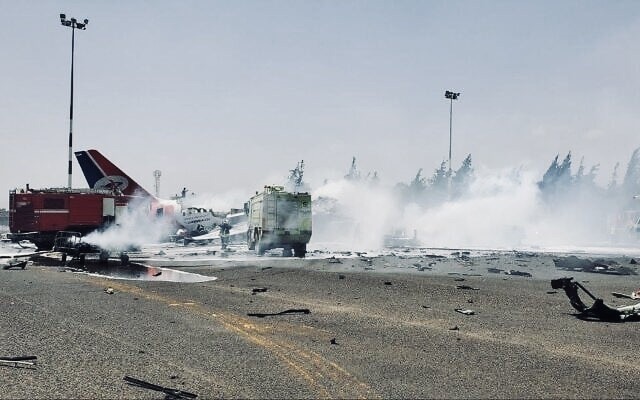
This pro-Iranian, ideologically-driven, and stubborn militia in Yemen continues to fire missiles and drones at Israel despite sixteen Israeli retaliatory air and drone strikes since last summer. These have targeted critical infrastructure such as ports, power stations, oil refineries, and northern Yemen’s only international airport.
Israel’s military campaign in Yemen culminated with a precise bombardment in Sanaa on August 28 that killed the Houthi prime minister, Ahmed al-Rahawi, and virtually wiped out his cabinet.
The ministers killed were: Foreign Affairs and Expatriates Minister Jamal Ahmed Amer, Economy, Industry, and Investment Minister Muin Hashem Ahmed al-Mahaqri, Electricity, Energy, and Water Minister Ali Saif Mohammad, Agriculture, Fisheries, and Water Resources Minister Radwan Ali al-Rubai, Justice and Human Rights Minister Mujahid Ahmed Abdullah Ali, Social Affairs and Labor Minister Samir Mohammad Bajala, Youth and Sports Minister Mohammad Ali al-Mawla, and Culture and Tourism Minister Ali Qasem Hussein al-Yafii.

In addition, the director of the Prime Minister’s Office, Mohammad Qasim al-Kubaisi, and the secretary of the Council of Ministers, Zahed Mohammad al-Amidi, were killed.
The Israel Air Force inflicted this stunning blow about a day after the Houthis upped the ante by launching a souped-up ballistic missile at Israel. It was the first time they had fired this kind of a projectile.
The virtual decimation of the Houthi political hierarchy in one fell swoop was a devastating and unprecedented loss to the Houthis, whose incendiary slogan is “Death to America, Death to Israel, and a Curse on the Jews.”
According to the Saudi newspaper Asharq Al-Awsat, Israel’s strike appears to have frightened the remaining leaders of the Houthis, who have fallen into a “state of confusion and panic.”
Prime Minister Benjamin Netanyahu characterized Israel’s strike as the opening shot of a relentless retaliatory campaign. “We are doing what no one else has done before us,” he said, referring to the assassination of Houthi political figures. “We will get to all of them.”
Defence Minister Israel Katz was just as emphatic.”This is just the beginning,” he said. “The Houthis will learn the hard way that those who threaten and harm Israel will get the same back ten-fold, and they will not be able to decide when it stops.”
The commander of Israeli forces, General Eyal Zamir, has labelled the Houthis as “a terrorist branch of Iran” that threatens “regional and international stability.”
Israel’s reprisals, as well as its threats, have hardly discouraged the Houthis.
On August 31, Houthi leader Abdulmalik al-Houthi said defiantly that they would not only keep attacking Israel, but escalate their attacks.

His colleague, Mahdi al-Mashat, the president of the Houthi governing council, also promised vengeance, predicting that Israelis will no longer be able to “taste the flavor of security.”
Due to these threats, the Shin Bet internal security agency has taken “special and unusual” measures to protect senior officials such as Netanyahu and Katz.
In the meantime, the Houthis have made good on their threats to strike Israel.
Today, the Israeli Air Force downed a Houthi missile. Yesterday, the Houthis fired two missiles at Israel, but they disintegrated over Saudi Arabia. Hours later, Israeli aircraft intercepted a drone before it could enter Israeli territory.
The day before, the Houthis fired a missile at an Israeli-owned tanker in the Red Sea, the Liberian-flagged Scarlet Ray, but it missed its mark.
The Houthis today are virtually Iran’s only proxy actively at war with Israel. Hezbollah’s military assets and bases in southern Lebanon were smashed by Israel in last year’s war. Hamas has been greatly degraded. Syria, following the collapse of the Assad dynasty last December, is no longer a member of Iran’s Axis of Resistance.
The Houthis, in a show of solidarity with Hamas, began attacking Israel and maritime traffic in the Red Sea and the Gulf of Aden in November 2023, about a month after Hamas terrorists killed roughly 1,200 people in southern Israel and kidnapped 251 Israelis and foreigners.
From November 2023 until December 2024, the Houthis targeted more than 100 ships with missiles and drones, sinking four vessels and killing eight sailors.
They stopped their attacks during brief ceasefires in November 2023 and January 2025.
Since March 18, when Israel resumed its offensive against Hamas in the Gaza Strip, the Houthis have launched 72 ballistic missiles and some 24 drones at Israel. Several missiles have fallen short.
Israel has downed the vast majority of Houthi missiles and drones, but at least two evaded Israeli defences. In July 2024, a missile struck an apartment building in central Tel Aviv, near the U.S. consulate, and killed a middle-aged man. Four months ago, a missile crashed into a wooded area close to Ben-Gurion Airport, causing panic in the main terminal building.
The United States escalated its attacks on Houthi bases earlier this year, but called them off after President Donald Trump announced that a truce had been reached with the Houthis.
In theory, Israel and the Houthis can achieve a ceasefire if the Israeli army withdraws from Gaza and ends the war there, two of the conditions set out by Hamas and the Houthi leadership.
Since the Israeli government has no intention of abiding by these terms, at least for now, the expectation is that the Houthis will continue to harass Israel and Israelis for the foreseeable future.