
Herbert Heller, a Czech Holocaust survivor, did not talk about his ordeal for 60 years. It was his deep, dark secret. Even his wife and children had no idea what he had gone through as a youth. But one day, he finally recounted his singular tale of strength and resilience.
His story is dramatically recreated in The Optimist, a feature film scheduled to be released in U.S. and Canadian theaters on March 11. Written and directed by Finn Taylor, and starring Stephen Lang as Heller, it moves seamlessly between the present and the past.
Its starting point is Marin county, California, in 2004. Heller’s physician has informed him that he should get his affairs in order. It seems as if he has been stricken by a terminal disease, but the details are left unsaid.
What is clear is that he is still traumatized by his Holocaust experiences. Shortly after leaving the doctor’s office, he is assailed by a hallucinatory image of a Gestapo officer.
Having been advised that his life is ebbing away, Heller, the owner of a toy store, decides to open the floodgates. Until now, he has clung to secrecy due to his belief that his memories would upset his family.
He unburdens himself first to Abbey (Elsie Fisher), a troubled young woman. She does not appear to be Jewish, but she is an attentive listener and receptive to his desire to come clean.
From this point forward, much of the film unfolds in Europe through flashbacks. The locales are Prague, Heller’s hometown; Terezin, a Nazi concentration camp in Czechoslovakia, and Auschwitz-Birkenau, a German extermination camp in Poland.
Heller’s father, an engineer, was confident that Czech Jews could survive the Nazi occupation. His optimism was grounded in self-delusion. Reinhard Heydrich, the German overseer in Prague, was bent on marginalizing, persecuting and deporting Jews. There is only passing reference to him in the movie.

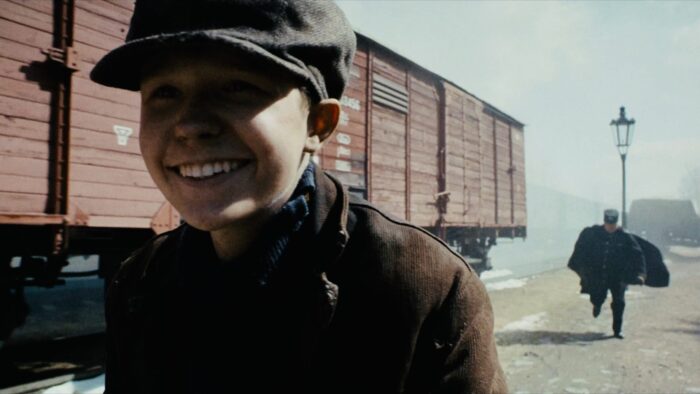
The incremental Nazi persecution of Czechoslovakia’s Jewish citizens is effectively chronicled in a few stark scenes. The young Heller (Luke David Blumm) is tormented and chased by a gang of neighborhood thugs. He and his family are compelled to wear the humiliating Nazi yellow star on their clothes. The Gestapo evicts them from their residence.
And in a jolting scene that conveys the temper of the times, masses of bedraggled Jews, carrying their belongings, are force marched through a street to an unknown destination.
They were sent to Theresienstadt, or Terezin, a way station to Nazi extermination camps in Poland. In 1942, the Heller family found themselves there. Conditions were difficult, but Heller busied himself as a gardener in its vegetable patch. Cynically, the Nazis portrayed Theresienstadt as an innocuous holding camp to the Red Cross.
Two years later, the Hellers were shipped to Auschwitz-Birkenau. The scenes in that camp are exceedingly graphic, a tribute to the first-rate cinematography.
Heller honed his survival skills in this purgatory. His father and brother were not as fortunate. Heller was consigned to the infamous death march from Auschwitz in January 1945, but he managed to escape and return to Prague before World War II ended. Strangely enough, his immigration to and resettlement in the United States go unmentioned. This omission leaves a yawning gap in the film.
Similarly, Heller’s conversations with Abbey, though a practical method of linking his life in California with his time in Europe, pale in comparison.
That being said, The Optimist is a vivid film, bolstered by strong performances from its talented cast. It succeeds in conveying the horror and the trauma to which Heller and his family were so brutally subjected.