
James Vanderbilt revisits the 1946 Nuremberg war crimes trial mainly through the perspective of two men on opposite sides of the aisle: Hermann Goring, who was Adolf Hitler’s second-in-command, and Douglas Kelley, the American army psychiatrist who was assigned to evaluate his personality and ascertain whether he was mentally fit to stand trial.
Vanderbilt’s movie, Nuremberg, is based on Jack El-Hai’s book, The Nazi and the Psychiatrist, and is two hours and 28 minutes in length. It is now playing in Canadian and American theaters.
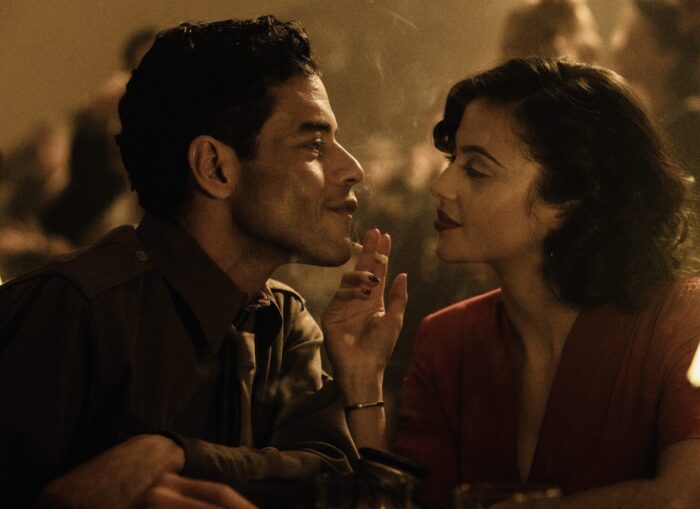
The plot is straightforward. Kelley (Rami Malek), keen to explore the mindset of a Nazi who was one of the architects of the Holocaust, is eager to learn why people are driven to commit acts of unspeakable evil.
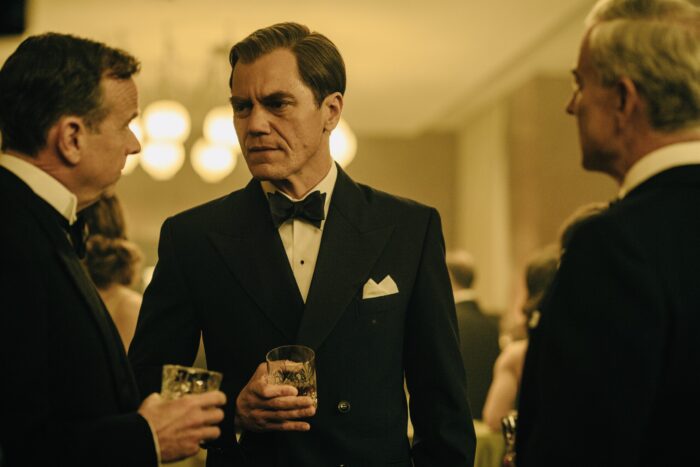
Robert Jackson (Michael Shannon), the chief American prosecutor, is equally interested in understanding Goring’s mentality and the atrocities of the Nazi regime. “The world needs to know what these men did,” he says early on in the film.
As Nuremberg suggests, this unprecedented and seminal trial, set in Allied-occupied Germany, was the subject of fierce debate in the United States even before it began.
Concerns abounded that it would give hardcore Nazis like Goring, one of 22 Nazi defendants, a platform to expound their noxious views and exonerate themselves. Proponents of this view demanded their summary execution.
Still others, like Jackson, a justice of the U.S. Supreme Court, appear to have been torn. In a brief but telling scene, he discusses this issue with the pope, who condemns the biblical notion of an eye for an eye and rejects the necessity of a trial. Jackson is offended by his argument and decides there and then that a trial is morally necessary.
This thought-provoking film begins on May 7, 1945, the last day of the war. As unidentified refugees in Austria trudge toward an unknown destination, an America soldier casually unrinates on a scuffed roadside marker inscribed with a swastika. It’s an unmistakable signal that the “thousand-year” Third Reich has crumbled after 12 years of existence.
Goring, ensconced in a fancy sedan with his family, is captured by a group of GIs and swiftly imprisoned. Kelley steps in, charged with interrogating and analyzing the reichmarshall, who was the minister of the economy and the commander of the German Air Force.

Smug, smart and self-confident, Goring (Russell Crowe) looks forward to the trial, being confident he can outwit Jackson and escape the hangman’s noose. Crowe, all bulked up and his hair tightly swept back, speaks German before lapsing into heavily-accented English. In an impressive performance, he portrays Goring as a cunning and manipulative Nazi.
Certainly, he is far more sophisticated than two of his co-defendants, Robert Ley and Julius Streicher. Ley, the coarse face of Nazism, claims he can “smell” a Jewish person from afar. Streicher, who edited the crudely antisemitic rag Der Sturmer, asks Kelley if he’s Jewish. Later, as his fate becomes clear, Streicher requests a Jewish lawyer, implicitly assuming that only a Jew can avert his execution.

The film unfolds chronologically, setting out the facts methodically, but in one instance it stumbles into implausibility. Its credibility is strained when Jackson, in a meeting with Kelley in a ruined stadium where Nazi rallies were held, explains the meaning of the 1935 Nuremberg Laws, which stripped German Jews of their citizenship and banned them from marrying Christians. Surely Kelley was aware of this racist legislation, but as a cinematic device, this scene keeps viewers informed and up to speed on Nazi antisemitic legislation.
In preparing for the trial, Jackson leans on Kelley’s growing body of knowledge about Goring. He believes that if Goring is to be convicted, his colleagues will have to be found guilty of war crimes as well.
As Kelley continues to question Goring, he concludes that he is a narcissist and an opportunist. Goring claims he is indifferent to Jews. He admits, implausibly, that the Nazi extermination of six million Jews is “a grave blight” on Germany. In trying to ingratiate himself with Kelley, he discloses that he was named after a distant Jewish relative.
Malek, who won an Academy Award for his vivid portrayal of British singer Freddie Mercury in the 2018 movie Bohemian Rhapsody, delivers a middling performance here. He shows flashes of intelligence and passion, but sometimes seems out of his depth.
The trial starts to unfold only one hour and 16 minutes into Nuremberg. Goring, having established his defence strategy, intends to accept responsibility for his own actions, but not for those of his fellow Nazis.
Jackson, describing the defendants as the “living symbols of racial hatred, terrorism and violence,” argues that they must be answersable to the law. The film’s authenticity is enhanced by black-and-white clips from the actual trial.
In the meantime, Kelley draws closer to Goring by visiting his wife and daughter. Kelley’s abhorrence of Nazi Germany grows after he watches a graphic documentary of emaciated and deceased concentration camp victims in camps such as Dachau, Bergen Belsen and Mauthausen. These horrific clips greatly heighten awareness of Nazi crimes.
As the trial proceeds, Goring accuses the United States of having committed war crimes in Japan and dismisses the trial as a “farce.”
In a poignant sequence outside the courtroom, Howie Triest (Leo Woodall) a Jewish American GI who serves as a German-to-English translator, tells his story to Kelley. Triest is a Jew who was hounded out of Germany and whose his parents were transported to the Auschwitz Birkenau extermination camp.
“It happened here because people let it happen,” says Triest in an apt commentary, suggesting that bad people can be found not only in Germany, but in all nations, including the United States.
One the strongest moments in the film occurs when a canny British prosecutor confronts Goring and proves beyond a reasonable doubt that he was a central figure in Germany’s descent into totalitarianism, state-sponsored antisemitism and genocide. In a grand finale, he lures Goring into the damning acknowledgment that he is an unrepentant Nazi.
Nuremberg, of course, is not the first movie to address the post- Nazi era. Judgment at Nuremberg, Stanley Kramer’s classic starring Spencer Tracey, appeared in 1961. Nuremberg is not as accomplished as Kramer’s version, but it acquits itself reasonably well thanks to an effective cast, a credible screenplay, and sharp cinematography. In a particularly riveting scene toward the end, the camera pans on a small pool of urine expelled by a Nazi war criminal who has just been hanged.
Beyond these elements, Nuremberg is valuable historically, inasmuch as it recounts a pivotal turning point in war crimes proceedings. The Nuremberg trial left the important message that war criminals cannot expect clemency if they are caught and convicted.
Nearly eight decades on, Nuremberg’s echoes remind us that human beings are capable of horrendous crimes.