
President Franklin D. Roosevelt mobilized the Hollywood film industry to boost national morale and enhance understanding of the United States’ participation in World War II.
Jewish directors and screenwriters ranging from George Cukor to Budd Schulberg played a significant role in wartime filmmaking. They produced documentaries and movies that were at once educational, entertaining and politically useful in the advancement of U.S. war aims.
As Michael Berkowitz observes in Hollywood’s Unofficial Film Corps: American Jewish Moviemakers And The War Effort (The University of Wisconsin Press), they were “extraordinarily effective” in assisting the U.S. armed forces and binding Americans together.
Roosevelt appreciated the importance of film in the war, which the United States entered on December 7, 1941 following Japan’s attack on the U.S. Pacific fleet at Pearl Harbor. “U.S. citizens’ cohesion and enthusiasm for the war effort was more fragile than is often assumed,” writes Berkowitz, a professor of modern Jewish history at University College London.
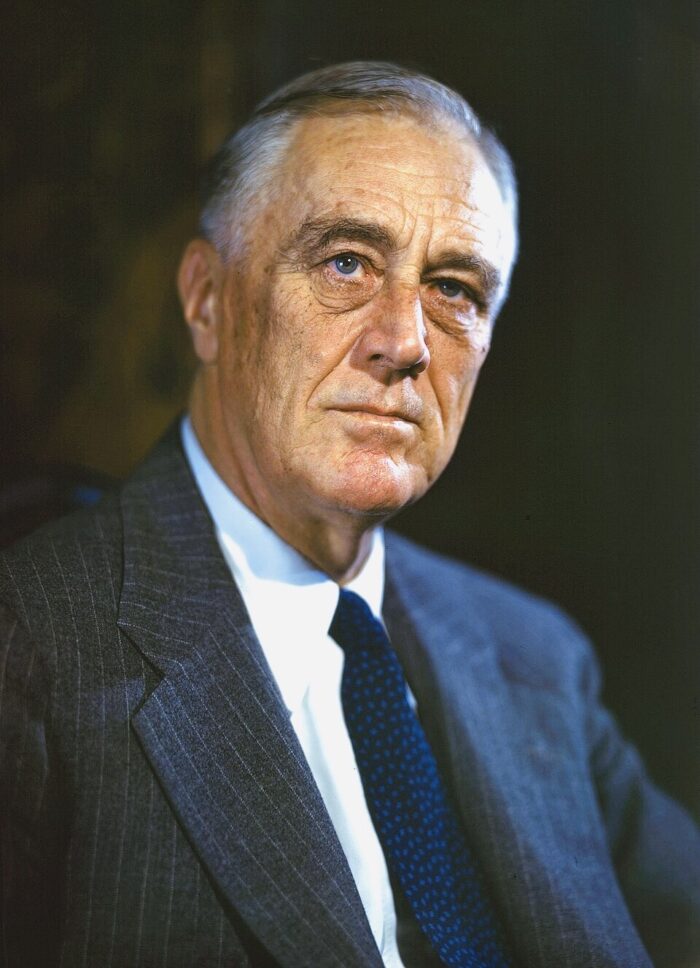
There was a strong strain of isolationism in the country, and the antisemites in their ranks firmly believed that U.S. involvement in the war could only serve Jewish interests. As a result, the Roosevelt administration was less than keen to publicize the Jewish contribution to these films and thereby “stir the embers of Jew hatred in America.”
Prior to 1941, Adolf Hitler’s Nazi regime frequently and vehemently charged that American Jews were meddling in its affairs and encouraging the U.S. to declare war on Germany.
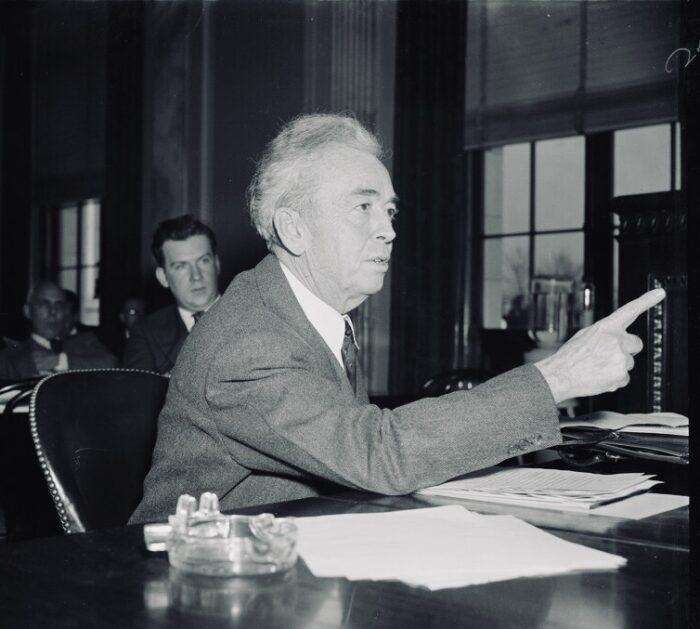
This nefarious theme was promoted by racist American politicians like John Rankin, a Democrat from Mississippi and an ardent supporter of the Ku Klux Klan who accused Jews of pushing the U.S. into war.
Consequently, the Roosevelt administration, with Hollywood’s full cooperation, placed non-Jewish movie producers and directors such as Darryl Zanuck and Frank Capra in the spotlight and did not always explicitly credit the contributions of Jews.

Nonetheless, Jews played an outsized role in critical areas like music scoring, scriptwriting, editing and cinematography, says Berkowitz, citing contributors like Jesse Lasky Jr., Stanley Kramer, Ernst Lubitsch and Paddy Chayefsky.
The figure who looms largest in this informative and thoroughly researched book is Leo Rosten, the screenwriter and the deputy director of the Office of War Information and the chief of the Motion Picture Bureau of the National Defence Advisory Commission. During the 1960s, he was the best-selling author of The Joys of Yiddish.
“Rosten was the driver behind the notion that movies could advance U.S. war aims in specific as well as general ways and also be compelling, even enjoyable,” says Berkowitz. “It was in the government’s interest, therefore, to produce and facilitate the making of movies that were unmatched in power and speed to influence opinion and to have the best industry people serving in the U.S. military.”
Berkowitz lists several important films that emerged during this relatively short period.
Sergeant York, directed by Howard Hawks and released in 1941, burnished the image of a legendary war hero.
The Why We Fight series, commonly attributed to Capra, was largely the brainchild of the emigre director Anatole Litvak. Officially made for the military, it was eventually released to the general public.
Cukor, reputedly Hollywood’s highest-paid director, churned out an instructional film about the building and placement of latrines.
It’s Up To You, sponsored by the Department of Agriculture, explained the need for rationing so that farmers could feed both soldiers in the field and civilians at home.
Schulberg was in charge of collecting photographic evidence of Nazi atrocities. His incriminating footage would be used to full advantage at the postwar Nuremberg war crimes trials.
Rosten devoted time and energy to locate and screen foreign films that could best serve U.S. objectives. A British feature film directed by Michael Powell and written by Emeric Pressburger, 49th Parallel, is an example.Yet this movie was controversial. It “epitomized precisely what the isolationist American congressmen and antisemites feared: a vehicle … to draw the United States into war or, at the very least, to galvanize support for the Nazis’ opponents.”
Films about the Holocaust were conspicuously missing, even though Jews were integral to wartime films. The fate of European Jews in Nazi-occupied countries surfaced only on the eve of Germany’s unconditional surrender in May 1945. “Even then, great pains were exerted to show that they were part of a broad tapestry of Nazi victims,” says Berkowitz.
There was “great anxiety” in Washington that publicizing the mass murder of Jews “might cause the war itself to be seen as a Jewish war.”
In closing, Berkowitz expresses admiration for the movies that Hollywood produced in collaboration with the U.S. government. More than 80 years on, he notes, they are “surprisingly watchable.”
Berkowitz resurrects this important footnote in Hollywood lore with erudition and clarity.