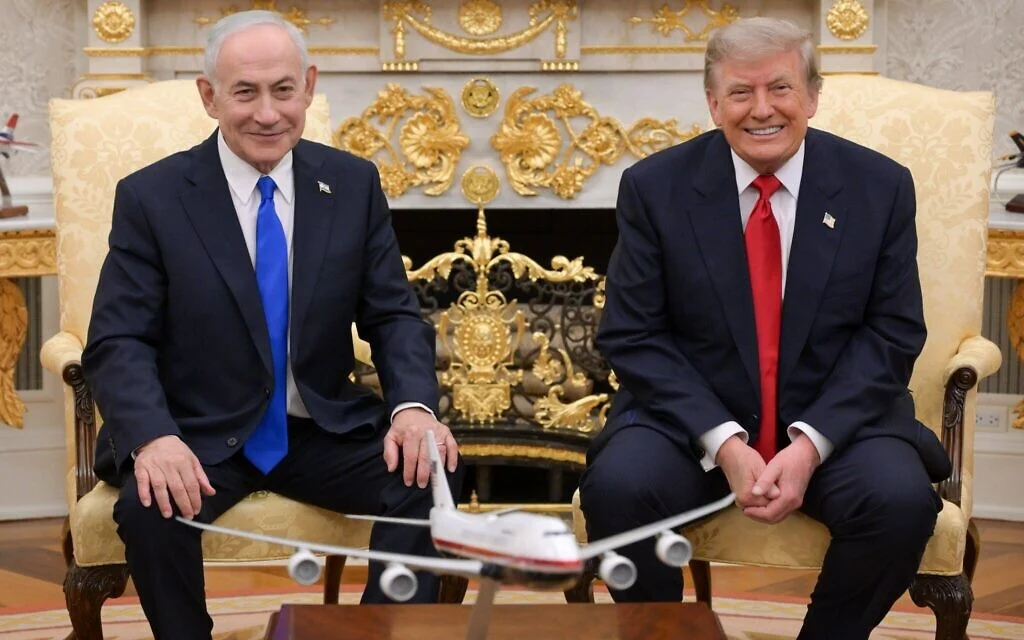
Prime Minister Benjamin Netanyahu’s meeting with President Donald Trump at the White House on July 28 unfolded against the backdrop of their divergent priorities regarding the lingering war in Iran.
Netanyahu seeks a more aggressive approach to Iran, being intent on finishing a war that was paused by a ceasefire that has been repeatedly broken by the Iranian regime since April.
He believes that additional attacks are needed to further degrade Iran’s remaining capabilities.
Netanyahu wants to destroy what is still left of Iran’s nuclear infrastructure, eliminate its stockpile of ballistic missiles and drones, and weaken its Axis of Resistance, which is composed of Hezbollah, Hamas, militias in Iraq and the Houthis of Yemen.
With a general election in Israel due to take place on October 27, Netanyahu is particularly eager to resolve these issues to increase his reelection chances.
With an eye on midterm elections in November, Trump seeks an agreement with Iran that will extricate him from a protracted and unpopular war. This conflict has led to the virtual closure of the Strait of Hormuz, the disruption of the global economy, and a spike in oil and natural gas prices in the United States.
In short, the unfinished war in Iran was on Netanyahu’s mind as he flew to Washington, while the unfinished negotiations with Iran consumed Trump.
When he and Trump launched joint military operations in Iran on February 28, there was no daylight between them inasmuch as they shared identical objectives. Since then, however, their interests have diverged.
Netanyahu arrived at the White House several days after Trump cancelled a series of U.S. air strikes in Iran and announced that his envoys are trying yet again to negotiate a deal with the Iranian regime. Mediators from Pakistan, Egypt and Qatar have been discussing a proposal that would clarify disagreements regarding operations in the Strait of Hormuz.
Iran insists that a Memorandum of Understanding (MoU), signed last month, granted it a large level of control over the international waterway. The United States disagrees with Iran’s view.
Israel opposed the MoU, arguing that it strengthened Iran’s hand.
According to Barak Ravid, an exceptionally well-informed Israeli journalist based in the United States who writes for Axios, a considerable number of senior officials in Trump’s inner circle currently view Netanyahu with a measure of disdain. They believe he was too confident of what an air campaign in Iran could achieve. Still other U.S. officials, including Vice President JD Vance, think that Netanyahu’s overly optimistic assessments have not panned out.
Due to these perceptions, Netanyahu was weaker and less influential than last winter, as Ravid noted.
Netanyahu, relying on Mossad assessments, told Trump that the Islamic regime, having been weakened by street protests in January, could be toppled. He said that Iran’s ballistic missile and missile programs could be badly degraded, if not destroyed, within a few weeks. He predicted that Iran would probably not attack U.S. bases in the Arab Gulf States. And he said that Iran, having been battered by U.S. and Israeli air strikes, would be unable to block traffic through the vital Strait of Hormuz, through which 20 percent of the world’s oil and liquified natural gas passes.
His predictions have not materialized.
The regime in Iran is still standing and may well be more radical than before the war. And none of the United States’ and Israel’s war aims have been achieved.
As a result, Netanyahu is quite unpopular in Washington these days, not only in Trump’s circle and his Make-America-Great-Again base, but among Democrats, all of whom feel that Israel dragged the United States into what could be a “forever” war.
In private, Trump has reportedly expressed frustration with Netanyahu, but in public he claims that his longstanding relationship with Netanyahu remains intact and very good.
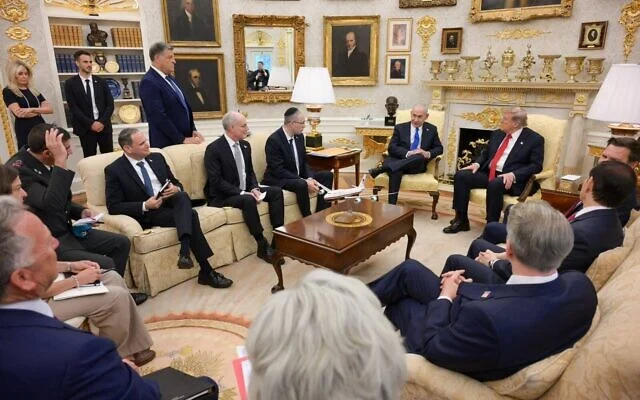
Netanyahu’s 90-minute meeting with Trump, their first since February and their eighth since Trump’s inauguration in January 2025, was held behind closed doors. There was not a press conference afterwards.
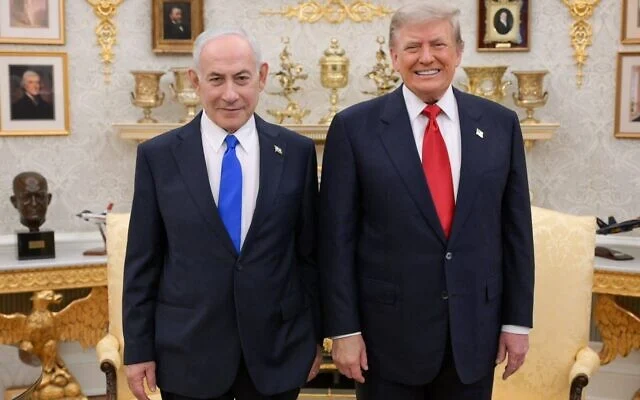
Netanyahu described it as “excellent” and “one of the best conversations I have had with the president of the United States.” He told Israeli media that they had “an understanding of a shared goal, to ensure that Iran does not have nuclear weapons, and other goals as well.”
Trump did not speak to reporters following the meeting, but said that his talks with Netanyahu had been “very good.” On his Truth Social site, he wrote, “Obviously, many important subjects were discussed.” White House press secretary Karoline Leavitt said that their conversation was “positive and productive.”
No details were released, but Netanyahu had been expected to brief Trump about Iran’s efforts to rebuild its nuclear program in the Pickaxe Mountain area, the New York Post reported. According to the newspaper, Netanyahu would tell Trump that Iran is lying about its interest in pursuing a diplomatic solution to the conflict.
The Wall Street Journal reported that Israel had uncovered proof that Iran moved centrifuges to the mountain complex shortly after the United States and Iran signed the MoU to end the war and reopen the Strait of Hormuz.
The head of Israel’s Public Diplomacy Directorate, Tzipi Hotovely, denied these reports. “The issue of Pickaxe Mountain did not come up,” she said. “Reports claiming Israel arrived with intelligence on the matter are fake.”
After their meeting, Trump and Netanyahu left the White House to attend a memorial service for the late, pro-Israel Republican senator from South Carolina, Lindsey Graham.
Prior to Netanyahu’s trip to Washington, Defence Minister Israel Katz disclosed that U.S. aircraft involved in the bombing of Iranian military and civilian targets in Iran of late took off from Israeli Air Force bases. Katz said that the Iranian regime is aware that Israel has been hosting U.S. planes. “They know that American aircraft are taking off from here … to strike.”
He told Channel 14, a pro-government news channel, that the Trump administration had stopped Israel from launching a new wave of bombings in Iran. “We very much want to strike Iran’s energy targets. The United States is not approving it at the moment because of the concern that Iran would attack neighboring countries, causing a global oil crisis. As far as we’re concerned, we’re prepared to set (Iran) back 40 years.”
Less than a day after the Trump/Netanyahu meeting, Iran struck American forces in Jordan, prompting Trump to say that he intended to “beat the fucking shit” out of Iran. “We’ll be hitting them hard,” he told Fox News. “They’re going to get a beating.”
Shortly afterward, the U.S. and Saudi Arabia bombed pro-Iranian militias in Iraq, blaming them for drone attacks on Saudi oil facilities.
It would appear that the war in Iran has yet to be finished. It may go on far longer than Trump ever anticipated or desired.