
Israel’s recognition of Somaliland as a sovereign state came as a bolt out of the blue, but it was hardly surprising. Israel, the first nation to formally recognize Somaliland, has had a longstanding and clandestine relationship with it.
When the State of Somaliland won independence from Britain in 1960, Israel was among the 34 countries that recognized it. Under colonial rule, Somaliland was known as British Somaliland.
Somaliland’s quest for nationhood was very transitory. Within five days of its declaration of independence, Somaliland chose to unify with Somalia, a Muslim country on the Horn of Africa. In 1991, Somaliland broke away from Somalia, which has never recognized Israel.
In 1995, the then president of Somaliland, Ibrahim Eyal, wrote a letter to Israeli Prime Minister Yitzhak Rabin seeking to establish diplomatic relations. He cited the need for a joint effort to counter Islamism in the region.
The Mossad, the Israeli external intelligence agency, reportedly cultivated discreet relationships in Somaliland to pave the way for a future rapprochement.
To no one’s surprise, the Somali government described Israel’s announcement last month as a direct assault on its sovereignty. President Hassan Sheikh Mohamud accused Israel of violating international norms and claimed that Somaliland is an integral part of Somalia. He said he would pursue diplomatic and legal measures to counter Israel’s “unlawful” and “deliberate” move to legitimize Somaliland’s secession from Somalia.
His position was endorsed by the Organization of Islamic Cooperation, which warned of “serious repercussions” for regional and global security.
Egypt, backed by Turkey and Djibouti, rejected any “unilateral measure that could undermine Somali independence” or erode the foundations of its stability. Turkey, Israel’s regional rival, has close ties with Somalia, having trained its security forces and supplied development assistance in exchange for a foothold in the Horn of Africa.
The African Union Commission issued a statement rejecting any initiative “aimed at recognizing Somaliland as an independent entity” and insisted that Somaliland “remains an integral part” of Somalia.
The European Union criticized Israel’s recognition, while the United States said it would continue to recognize the territorial integrity of Somalia, “which includes the territory of Somaliland.”
Israeli Foreign Minister Gideon Saar, who visited Somaliland on January 6, eleven days after Israel’s recognition, was not discouraged by these barbs. Asserting that Israel was “truly honored” to be the first nation to recognize Somaliland, he called it a pro-Western nation “friendly to Israel.”

Speaking alongside its president, Abdirahman Mohammed Abdullahi, Saar dismissed “the attacks, the criticism and the condemnations” that Israel’s recognition had elicited. As he put it, “Nobody will determine for Israel who we recognize and with whom we maintain diplomatic relations.”
During Saar’s whirlwind trip, Abdullahi disclosed that Somaliland would join the Abraham Accords, an agreement brokered by the United States to normalize Israel’s relations with the United Arab Emirates, Bahrain and Morocco. Sudan also signed the accords, but its bilateral relations with Israel have not advanced due to its ongoing civil war.
Abdullahi expressed “deep appreciation” for Israel’s “historic and courageous” decision. “This milestone reflects a relationship founded on mutual respect and shared interests,” he said, adding that Somaliland is a “reliable and responsible partner.”
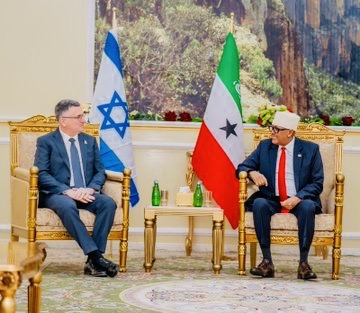
Israel and Somaliland agreed to open embassies in each other’s capitals and appoint ambassadors. Prime Minister Benjamin Netanyahu invited Abdullahi for an official visit to Israel, and he accepted the invitation. A date has yet to be set.
Netanyahu said that Israel would pursue cooperation with Somaliland in agriculture, health, technology and the economy.
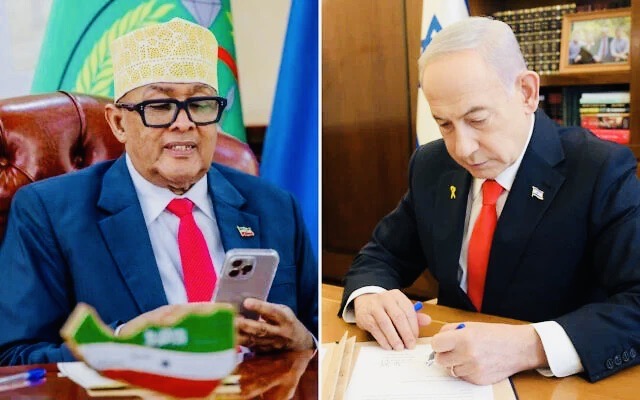
Somaliland, in a post on X, officially denied that it had agreed to accept Palestinian refugees from the Gaza Strip or to permit Israel to establish military bases on its soil in exchange for its recognition.
On January 8, however, a senior official in Somaliland’s Foreign Ministry, Deqa Qasim, told Israel’s Channel 12 that relations with Israel might well entail discussions on the establishment of an Israeli military base in Somaliland. Such a base would be a counterweight to Turkey’s military presence in Somalia.
Saar told Channel 14 that the resettlement of Palestinians in Gaza “is not part of our agreement with Somaliland.” But he did not rule out that scenario.
Somaliland, a semi-arid state with its own currency and flag, hopes that Israel’s recognition will break decades of diplomatic isolation and encourage other countries to follow suit.
Reports suggest that Ethiopia and India may be next in line. At present, Ethiopia and Taiwan have representative offices in Hargeisa.
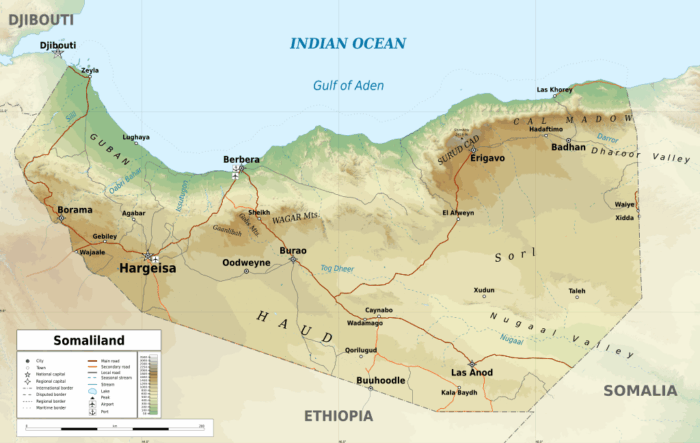
Somaliland, or the Republic of Somaliland, is 176,000 square kilometers in size and has a population of 6.2 million. Its capital, Hargeisa, has more than one million inhabitants. Its economy is based mainly on agriculture and the breeding of livestock.
Somaliland is strategically placed, being close to the Red Sea, the Gulf of Aden, the Indian Ocean and the Bab el-Mandeb Strait, a critical maritime corridor through which global trade flows and superpower competition intersects. Its port of Berbera gives it access to busy shipping lanes.
Ships plying those routes have been attacked by the pro-Iranian Houthi militia of Yemen, posing a threat to global commerce. In addition, the Houthis fired missiles and drones at Israeli cities during Israel’s two-year war with Hamas in Gaza.
Israel, therefore, has a vested interest in forging beneficial ties with Somaliland. It could give Israel immense political and military leverage in the Horn of Africa, reminding enemies, such as the Houthis, that they are more vulnerable than in the past.
As Eyal Zisser, an Israeli scholar, writes, Israel’s recognition of Somaliland should be viewed in perspective.
“The outreach to Somaliland should be seen as part of a broader strategic picture aimed at building a network of cooperation between Israel and its neighbors. At the forefront are Greece and Cyprus, with which Israel has forged an intimate partnership that includes military and security dimensions. Alongside them are Jordan and Egypt, now bound to Israel through economic agreements that have made them dependent on Israeli supplies of gas and water. Finally, there is the United Arab Emirates, which only recently signed arms procurement agreements with Israel worth billions of dollars.”
In short, he concludes, Israel’s diplomatic stroke is “a necessary move that complements, deepens and secures Israel’s military achievements” since the outbreak of the Gaza war in 2023.