
Israel’s occupation of the West Bank often interferes with the mobility of its Palestinian inhabitants, especially when they need to travel to Israel. This restriction is one of the sore points of the nearly three million Palestinians in the West Bank, which has been occupied by Israel since the 1967 Six Day War.
Shai Carmelli Pollak’s The Sea, which is built around this contentious issue, will be screened at the Toronto Jewish Film Festival. It runs from June 4-14.
The movie unfolds as a bus en route to Tel Aviv’s seashore stops at an Israeli checkpoint. It is filled with Palestinian school children from a West Bank village near Ramallah. They are looking forward to spending a day at the beach, which seems very far from their homes.
The Israeli soldier who inspects the bus allows all but one of the passengers to proceed into Israel. He refuses to let in Khalid (Muhammed Gazawi), a 12-year-old boy, because he does not have a proper entry permit. Khalid is very disappointed.
When he realizes that his father cannot fix this problem, he decides to cross into Israel illegally. On the way to the border, he meets a group of Palestinian day laborers heading for jobs in Israel. He ends up in the Tel Aviv suburb of Bnei Brak, an ultra-Orthodox enclave.
Khaled seems taken aback by the heavy traffic and the high-rise buildings of a busy modern metropolis. It is probably his first time in Israel.
Possessing no knowledge of Hebrew or of the city he suddenly finds himself in, Khaled is dazed and confused. As the soulful Khaled, Gawazi is perfectly cast. His first encounter with Israelis is less than smooth, but the Jewish Israelis he subsequently encounters treat him nicely.
Spying an Israeli Arab woman on a bus, he asks for directions. She is helpful.

His father, Ribhi (Khalifa Natour), a Hebrew speaking undocumented construction worker at a nearby site, sets off looking for his son. Before he embarks on his frantic search, a co-worker gives him a yarmulke to wear, knowing he may otherwise arouse the suspicion of some Israelis. Such is the atmosphere in Israel today.
In the meantime, Khalid continues walking toward the sea, not being certain he is heading in the right direction. He stops another Arab woman, and she helps him.
Ribhi flags down a taxi in his desperate effort to locate Khaled. The Jewish driver assumes he is a Jew and launches into a friendly monologue about his synagogue. Once he realizes that Ribhi is an Arab, he practically freezes over. His reaction is a vivid reflection of the conflict between Israel and the Palestinians and of the fear that Israelis harbor of Palestinian terrorism.
After leaving the taxi, Ribhi walks into a shop. Much to his astonishment, he meets a gentle Jewish woman he once knew, and she is kind to him. Clearly, some Israelis relate to Arabs easily.
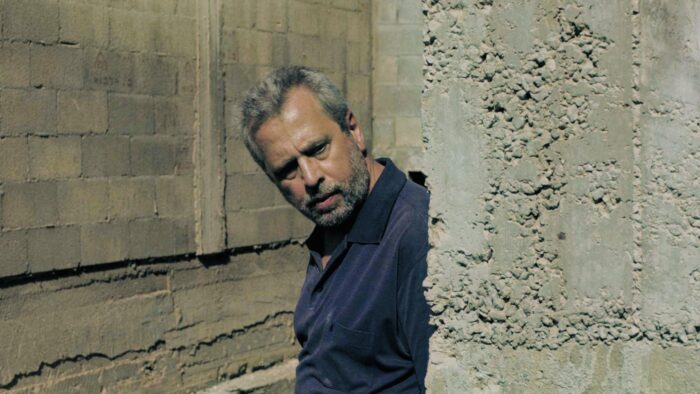
Ribhi finally catches up with Khaled, but the circumstances under which their paths converge are less than ideal. In fact, the final scenes are harrowing and shattering, a testament to a good screenplay and Pollak’s able direction.
Although The Sea is not a polemical film in the strictest sense of the word, it is impregnated with political undertones implicitly critical of Israel’s occupation of the West Bank and of the state of Jewish-Palestinian relations.
For this reason, there will be Israelis who may criticize this finely modulated film. Objectively speaking, however, The Sea is anything but a propaganda film. It raises points well worth pondering and debating.