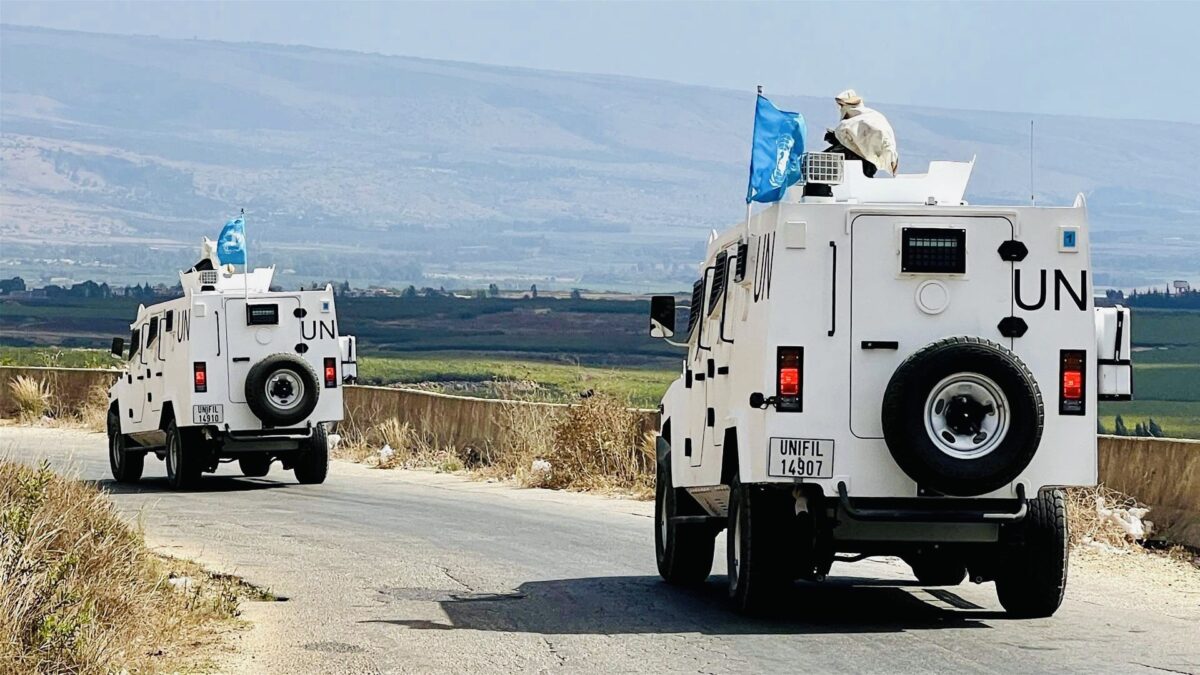
The United Nations has finally woken up to the reality that the United Nations Interim Force in Lebanon (UNIFIL) is little more than a white elephant that should be retired to pasture. Acting on this realization, the United Nations Security Council voted unanimously on August 28 to terminate UNIFIL’s peacekeeping mission in southern Lebanon by the end of 2026.
The UN is proceeding on the assumption that Lebanon will finally take take charge of security there once UNIFIL has been disbanded.
UNIFIL was created in March 1978 following Operation Litani, Israel’s first full-scale invasion of Lebanon. Israel struck after Palestinian terrorists based in Lebanon perpetrated the coastal road massacre, which resulted in the deaths of 39 civilians.
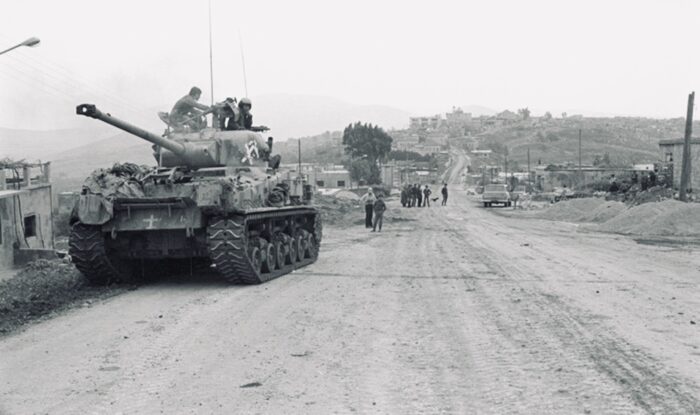
UNIFIL was tasked with monitoring the withdrawal of Israeli forces from southern Lebanon, restoring peace and security in that area, and assisting the Lebanese government to assert its authority there.
From the perspective of 47 years, UNIFIL has failed that test.
Apart from having confirmed the phased pullout of the Israeli army from southern Lebanon in 1978 and again in 2000, UNIFIL proved to be powerless in achieving its second and third objectives.
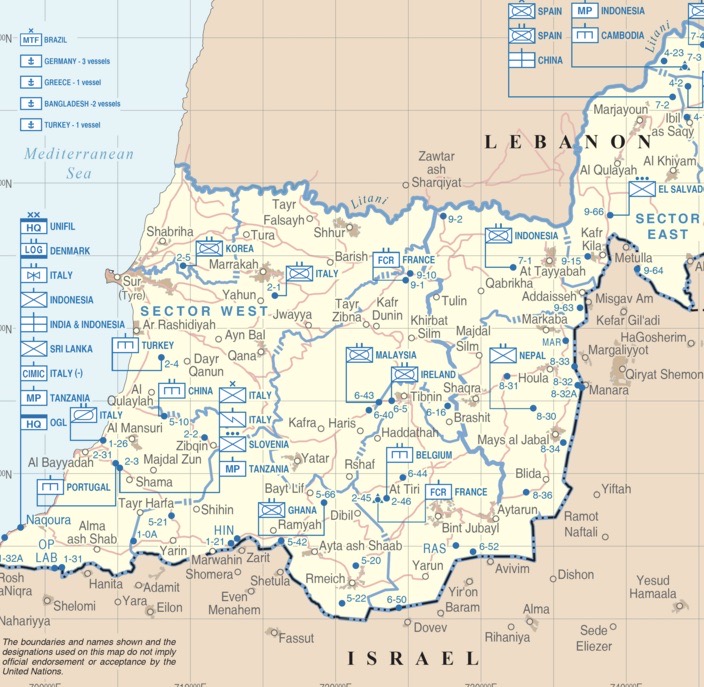
Hezbollah, a Shi’a militia created by Iran in the wake of the 2006 war in Lebanon, bulldozed over UNIFIL and effectively seized the region south of the Litani River — a distance of some 30 kilometers from the Israeli border — and became the most powerful military force in the country.
The toothless Lebanese army exercised little or no control over southern Lebanon, tacitly allowing Hezbollah to drag the country into periodic clashes and wars with Israel. These explosions greatly damaged Lebanon’s economy, shattered its security, and underscored the Lebanese government’s unwillingness or inability to assume real responsibility for asserting its sovereignty in southern Lebanon.
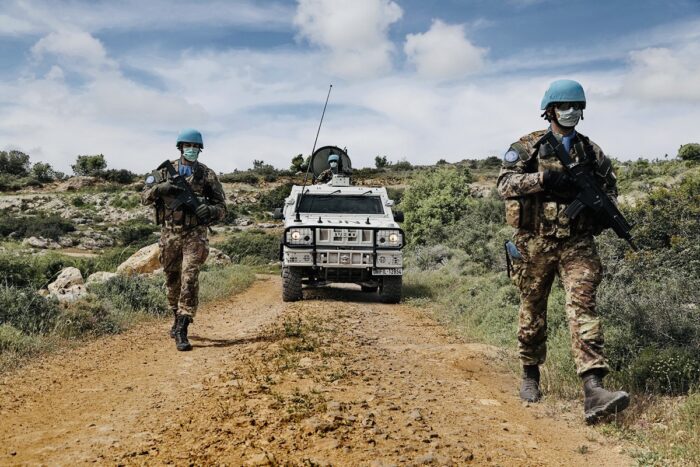
UNIFIL, which is based in Naqoura, across the border from Rosh Hanikra in Israel, observed these violent eruptions passively because it has no mandate to use force except in self-defence. From its inception, UNIFIL neither challenged the Palestine Liberation Organization nor Hezbollah, focusing almost exclusively on searching for illegal arms and reporting its findings to the ineffective Lebanese army.
This was an exercise in futility because UNIFIL, with a current strength of 10,801 peacekeepers from a diverse range of countries, turned a blind eye to Hezbollah’s military buildup, which was aided and abetted by Iran.
Supremely confident that Israel was a paper tiger, Hezbollah, in a reckless show of solidarity with Hamas, began bombarding Israeli towns and kibbutzim in the Galilee a day after Hamas’ invasion of the western Negev on October 7, 2023. Israel responded with force, and these tit-for-tat daily exchanges degenerated first into a relatively low-intensity conflict and then into a war in the autumn of 2024.
During the hostilities, Israel mauled Hezbollah, killing its political and military leadership, obliterating its bases in southern Lebanon, and destroying a substantial proportion of its rocket and missile arsenal, caches of weapons, and tunnels near the Israeli frontier.
Since last November’s ceasefire, which ended the war, Israel has established five bases in southern Lebanon close to its border and has continued to strike Hezbollah operatives and facilities. On August 31, in its latest operation, the Israeli Air Force bombed Hezbollah underground bunkers in the Beaufort Ridge area of southern Lebanon.
With Hezbollah having been severely weakened, UNIFIL’s raison d’être in southern Lebanon has been rendered irrelevant. “The time has come for UNIFIL’s mission to end,” Dorothy Shea, the acting U.S. representative at the United Nations, said a few days ago.

Disbanding UNIFIL will save the United Nations $500 million annually, a tidy sum that can be better spent on rebuilding towns and villages damaged by the fighting in Israel and Lebanon.
It is now incumbent on the often weak-willed Lebanese government to vigorously assert its authority in southern Lebanon, a task it should have undertaken decades ago.
Lebanon’s first step is to disarm Hezbollah, which is extremely reluctant to lay down its arms. This vital objective cannot be achieved unless the Lebanese army is sent southward to ensure that southern Lebanon does not again become a platform from which terrorists can attack Israel.
It is debatable whether the Lebanese government has the gumption to disarm Hezbollah. As the commentator Jonathan Spyer writes, “The government of Prime Minister Nawaf Salam has made clear that it has no intention of seeking to use force to induce (Hezbollah) to do so. Given Hezbollah’s infiltration of state institutions, including the Lebanese armed forces, it is not clear that the government would be able to employ coercive measures even if it wished to. The continued Lebanese dread of civil war also plays a role here. Only Israel’s ongoing campaign to prevent Hezbollah’s rebuilding of its forces is likely to be effective.”