
The United States is normalizing its frayed relationship with Syria, a key Arab state struggling to rebuild itself after a ruinous 12-year civil war.
It is bound to be an incremental process, judging by Syrian President Ahmed al-Shara’s visit to Washington on November 10.
A former jihadist who seized power after overthrowing President Bashar al-Assad last December, he was the first Syrian head of state to be invited to the White House.

He was welcomed warmly by President Donald Trump. But dispensing with the protocol afforded to foreign guests, Trump refrained from greeting Shara outside the White House. Instead, Shara was ushered into the building through a side door.
Despite the apparent snub, Trump spoke highly of him.
“The Syrian president is a strong man, and I get along with him very well,” he said. “He is doing a good job, and we have made great progress with Syria.”
This was their third meeting in six months and an unmistakable sign of the importance the United States attaches to improving its mercurial bilateral relations with Syria and drawing Syria, a former Russian client state, into the Western orbit.
Trump was introduced to Shara in Riyadh on May 14 at a meeting hosted by Crown Prince Mohammed bin Salman of Saudi Arabia.
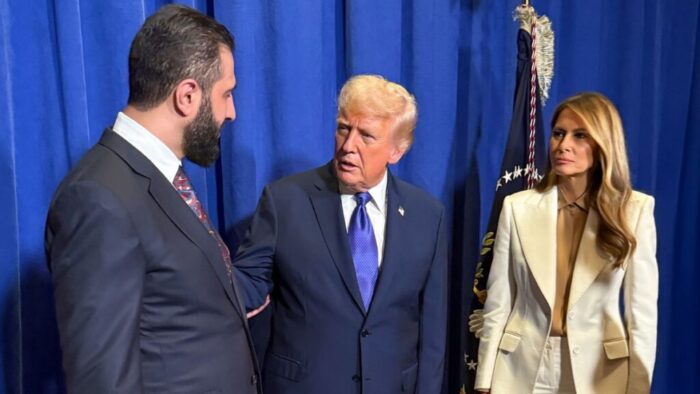
Trump met him again in New York City on September 25 on the sidelines of the United Nations General Assembly. Shara, the former commander of the Hayat Tahrir al-Sham rebel group, was in New York to address the United Nations. He was the first president of Syria to do so in almost 60 years.
In the past eleven months, since the downfall of Assad’s authoritarian regime, the United States has gone to great lengths to repair its ties with Syria, known throughout the Arab world as the beating heart of Arab nationalism.
Washington’s ties with Damascus have been extremely uneven.
Syria severed its relations with the United States in the mid-1950s and again during the 1967 Six Day War. They bounced back during the first Gulf War in 1991 and in the wake of Al Qaeda’s destruction of the Twin Towers in Manhattan on September 11, 2001.
The United States closed its embassy in Syria in 2011 shortly after the outbreak of the civil war. The embassy has yet to be reopened, though the Czech Republic represents U.S. interests in Syria.
During this period, Washington imposed biting sanctions on Syria. But after Assad’s overthrow, the United States offered Syria an olive branch.
Last December, President Joe Biden dropped the $10 million bounty on Shara, who fought with Al Qaeda following the U.S. invasion of Iraq in 2003. He broke away from Al Qaeda in 2016 to form Hayat Tahrir al-Sham, which spearheaded the rapid offensive which deposed Assad, who fled to Moscow with his family.
On May 23, in a bold shift, the Trump administration officially lifted economic sanctions on Syria. This cleared the way for Syria’s future reconstruction, which is expected to cost more than $200 billion, and for new foreign investment. Announcing his decision, Trump said, “It is time to give Syria a chance, and I wish it good luck.”
On November 6, the United States drafted and advanced a United Nations Nations Security Council resolution removing Shara, 43, from a terrorist list. The motion was passed unanimously. This will allow him to travel more freely.
And now the Trump administration is urging the U.S. Congress to repeal the Caesar Syria Civilians Protection Act. Passed by the U.S. House of Representatives on November 15, 2016 to punish Assad for war crimes, it was signed by Trump on December 21, 2019.
During Shara’s closed-door visit at the White House, Trump granted Syria a temporary waiver from the Caesar Syria Civilians Protection Act. The suspension will halt all sanctions against Syria with the exception of transactions involving two of its old allies, Russia and Iran. Shara reportedly requested a permanent repeal.
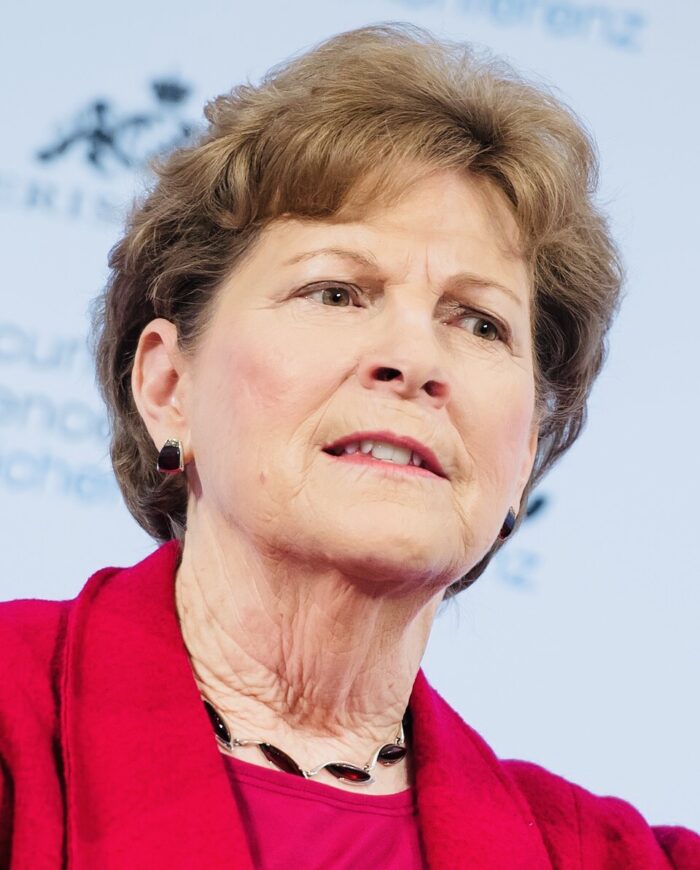
While several influential Democratic members of Congress have called for the lifting of the Caesar sanctions, a few Republicans want them to remain in place. Senator Jeanne Shaheen, a Democrat on the Senate Foreign Relations Committee, wants them ended without conditions. Senator Lindsey Graham, a Trump ally, has set conditions for repeal.
Trump disclosed that the decision to lift sanctions on Syria came at the request of Turkey and Israel. “We lifted the sanctions on Syria to give it a chance, and we think it is doing a good job so far,” he said four days prior to his meeting with Shara.
The U.S. special envoy to Syria, Tom Barrack, pushed for lifting sanctions as well.
During his White House visit, Shara agreed to join the U.S.-led Global Coalition to Defeat the Islamic State.
Islamic State established a caliphate in Syria and Iraq in 2013 and 2014, but it was destroyed by the United States and its regional allies in 2017. Nevertheless, Islamic State still maintains a presence in both countries, necessitating the need for the United States to maintain bases and a small number of troops in Iraq and northeastern Syria
In the last few months, Syria has foiled two Islamic State plots to assassinate Shara, who is trying to consolidate power amid bursts of sectarian violence, which has claimed the lives of hundreds of Syrians from the Alawite and Druze minority communities.
These incidents have damaged Shara’s image, but they have not deterred the United States from forging closer ties with Syria.
Following his visit to the White House, Shara told Fox News that Syria and the United States are now allies. “Syria is no longer looked at as a security threat, it is now looked at as a geopolitical ally,” he said in a remarkable comment. “It’s a place where the United States can have great investments, especially extracting gas.”
U.S. Secretary of State Marco Rubio, having met Shaara, said that both countries are working together on “unique and exciting opportunities” regarding Syria’s future, a prospect that seemed “unimaginable” only two years ago.
In a reference to Iran and Hezbollah, Rubio said that Syria is no longer a base for foreign countries such as Iran and Islamic fundamentalist organizations like Hezbollah, both of which regarded Syria as a platform from which to attack Israel and destabilize the region.
Rubio predicted that stability in Syria is bound to have a calming effect in the Middle East. “President Trump took a very bold step last May, and we continue to pursue and build on it,” he said.
Trump’s objective is to give Syria every chance to construct a strong, unified state that respects its ethnic and religious minorities and that is at peace with its neighbors, particularly Israel.
Since 1948, Israel and Syria have fought several wars and numerous skirmishes. But in recent weeks, they have engaged in U.S.-brokered negotiations to reach a border security agreement by the close of this year.
The United States reportedly seeks to establish an air base in Syria to monitor it, but the Syrian government has denied this report.
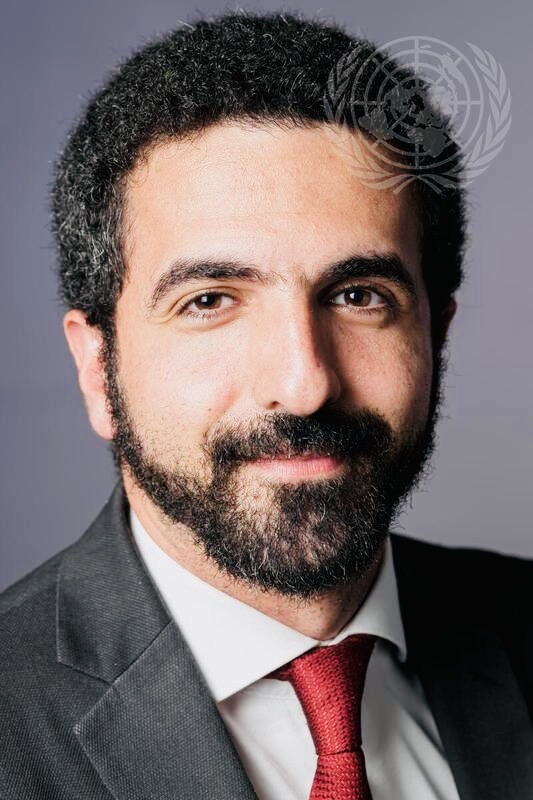
Syria’s permanent representative to the United Nations, Ibrahim Olabi, has said that ongoing discussions between Syria and Israel have focused on border points and troop numbers. Syria’s starting point, he said, is a return to the 1974 disengagement accord, which was brokered by the then U.S. Secretary of State, Henry Kissinger, during his rounds of shuttle diplomacy following the 1973 Yom Kippur War.
After Assad’s sudden fall, Israel seized the Syrian side of Mount Hermon and the United Nations demilitarized zone adjacent to the Golan Heights, which Israel captured during the Six Day War. Israel also set up nine observations posts in southern Syria.
As well, Israel bombed Syrian military assets, fearing they would strengthen Shara or fall into the hands of Islamic State or Assad loyalists.
Shara told The Washington Post on November 11 that Trump backs his insistence on a complete Israeli withdrawal from Syrian territory taken since last December as a condition for a comprehensive security deal with Israel. Trump will “push as quickly as possible to reach a solution for this,” he said.
Given its territorial demands, Syria has no intention of signing a formal peace treaty with Israel any time soon. Nor, as Shara noted yesterday, Syria is not yet ready to join the Abraham Accords, which is supposed to lead to a normalization of Israel’s relations with the United Arab Emirates, Bahrain, Morocco and Sudan.
“We are not going to enter into a negotiation directly right now,” he said in reaction to a reporter’s question about the possibility of Syria joining the Abraham Accords. “Maybe the United States administration, with President Trump, will help us reach this kind of negotiation.”
The prospect of an accommodation between Syria and Israel is an enticing proposition. If enacted, it could alter the political landscape of the Middle East.
The United States is working to achieve this seminal objective.