
Jewish settler violence against Palestinians in the Israeli-occupied West Bank is on the upswing, and Israel is doing virtually nothing to stop it.
The attacks have occurred on almost a daily basis, and Prime Minister Benjamin Netanyahu’s right-wing nationalist government has taken scarcely any steps to arrest and prosecute the perpetrators.
The Institute for National Security Studies at Tel Aviv University says that Israel has neither confronted nor suppressed the phenomenon, while the Israeli public is largely indifferent to it.
In the latest attack, on January 30, Israeli settlers went on a rampage in a Bedouin hamlet, setting ablaze several buildings and wounding two men.
Earlier last month, in separate incidents, masked settlers set fire to vehicles, vandalized property, stole livestock, and chopped down olive, date, fig and almond trees. During these incidents, several Palestinians were injured, according to the Palestinian Authority, which partially governs the West Bank.
These attacks do not surprise observers. They have been erupting periodically since Israel captured the West Bank during the 1967 Six Day War.
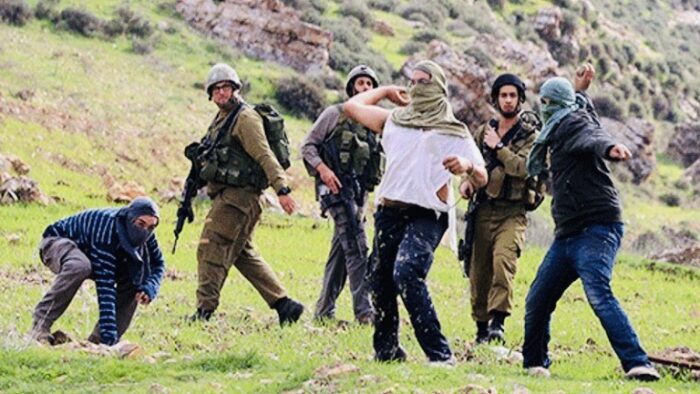
Two weeks ago, the Israeli army and the Shin Bet internal security agency released data concerning the upsurge of such violence, which has been committed by a band of extremists in the ranks of the settlement movement.
Last year, incidents of violence rose by 27 percent compared to the previous year, while the number of severe incidents, including shootings and arson, skyrocketed by over 50 percent.
During 2025, 867 incidents were registered, compared to 682 in 2024. In 2023, the year Hamas terrorists invaded southern Israel and killed roughly 1,200 Israelis and foreigners, the violence peaked, with 1,045 incidents recorded.
The consensus is that some 300 extremists from 42 unauthorized outposts in the West Bank have been behind the attacks.
The West Bank is home to approximately three million Palestinian Arabs and about 500,000 Jews. The Jewish inhabitants live in 140 authorized settlements and 224 illegal outposts and farms, according to Peace Now, which documents Israeli settlement construction and expansion.
Neither the Israeli government nor the army’s Central Command — which is responsible for security in the West Bank — have seriously clamped down on the perpetrators. Of the 70 hardcore extremists identified by the army and the Shin Bet, only 39 are under restraining orders signed by General Avi Bluth, the head of the Central Command.

The Institute for National Security Studies, in a recent monograph, says that the majority of Jewish-initiated violent incidents have taken place around Nablus and Jenin in the northern West Bank and in the South Hebron Hills.
The Jewish attackers, known as “hilltop youths,” have raided Palestinian villages and physically assaulted civilians and farmers, burned fields, homes and cars, and uprooted olive trees. At times, they have opened fire on Palestinians.
Hilltop youths, born and raised in the West Bank, are guided by radical theocratic ideas contemptuous of state authority.
“For them, Jewish sovereignty in the Land of Israel is a divine command that cannot be limited, and any relinquishment of territory by the government or the Israel Defence Force constitutes a betrayal of that command,” says the Institute for National Security Studies. “Some even refer to the Israeli government as a ‘hostile Zionist regime.'” Consequently, they have clashed with Israeli soldiers and police and damaged military vehicles.
Their violence “undermines the rule of law and constitutes an internal threat to governance and democracy in the State of Israel.”
Many of the vigilante attacks have fallen under the category of retaliatory “price-tag” attacks, triggered by Palestinian terrorism. Still others have been launched with the objective of driving out Palestinians from Area C, which comprises nearly two-thirds of the West Bank.
In recent years, the most violent settlers have seized Palestinian grazing and agricultural lands and built farms and outposts on them. A report released by Peace Now last year estimated that settlers have grabbed about 14 percent of the West Bank in this manner.
Their actions are supported by elements in the settlement movement, the government, and the security establishment. They form an integral part of Israel’s effort to control Area C — where Jewish settlements and army bases are located — and to establish irreversible facts on the ground.
Yesh Din, an Israeli human rights organization, contends that the Israeli law enforcement system has not protected Palestinians from Israeli violence.
“The failings of Israel’s law enforcement system can be observed in every aspect of its response to ideologically motivated crime by Israelis against Palestinians in the West Bank: ineffective prevention, failed police investigations, low indictment rate, and lenient sentences for convicted offenders. The fact that this is a longstanding systemic failure proves the State of Israel normalizes and supports ideologically motivated violence … as a matter of policy and benefits from its effects.”
ReliefWeb, an organization that monitors Israel’s activities in the West Bank, claims that “state-backed settler violence has become a key driver of forced displacement, chipping away at Palestinian presence in strategic locations. Such settler-driven displacement, particularly in Bedouin and herding communities, usually follows the same pattern: an illegal outpost is erected near or inside a herding community, settlers restrict Palestinians’ access to water and grazing space, settlers repeatedly attack communities, destroy property, infrastructure and livestock, and injure or kill residents.”
The United Nations’ Office for the Coordination of Humanitarian Affairs has documented the displacement of more than 700 Palestinian families linked to settler violence.
According to Israeli human rights group B’Tselem, 44 communities have been completely forced out since 2023.
Israel’s policy in the West Bank is driven by politicians, from Netanyahu on down, who fervently believe Judea and Samaria rightfully belongs to Israel by virtue of the Jewish people’s historical, religious and cultural connection to the ancient Land of Israel.
Finance Minister Bezalel Smotrich and National Security Minister Itamar Ben-Gvir, both of whom are settlers, have actively worked to tighten Israel’s grip on the West Bank and to smother attempts to foster Palestinian statehood.
Critics contend that both ministers enable violent settlers.
Smotrich has allocated substantial budgets to settlements and allowed security equipment to be distributed to illegal outposts. Ben-Gvir, having significantly eased firearm regulations, has issued more than 100,000 new gun licenses since the October 7 massacre. Settlers have received preferential access to weapons.
This permissive political climate emboldens a small minority of settlers to behave violently and with impunity. Hence the upsurge of Jewish vigilante attacks in the West Bank, a problem that stokes Israel’s existing tensions with the Palestinians.