
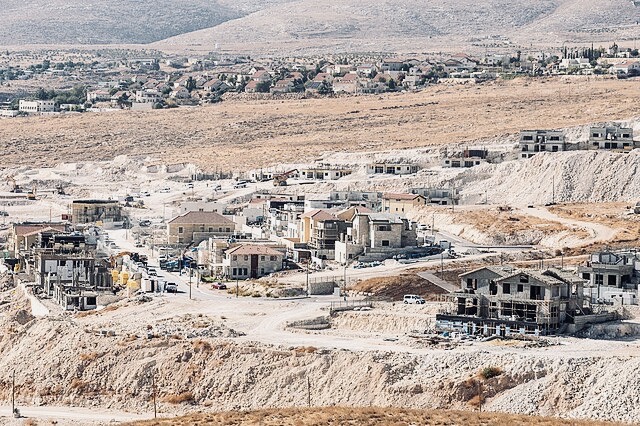
Israel’s security cabinet, acting on a resolution proposed by Finance Minister Bezalel Smotrich and Defence Minister Israel Katz, announced earlier this month that 11 new settlements will be built and 8 illegal outposts will be legalized in the West Bank.
Smotrich, a settler himself and an ardent champion of the settlement movement beyond the pre-1967 Green Line, explained that settlements are aimed at snuffing out the possibility of an independent Palestinian state. As he put it, “We are blocking the ground for the establishment of a Palestinian terror state. We will continue to develop, build and settle the land of our forefathers with faith in the justice of our path.”
Smotrich’s comments were in perfect harmony with the policy of Prime Minister Benjamin Netanyahu, whose right-wing government promotes settlements and rejects Palestinian statehood.
Last May, Israel announced that 22 new settlements would be constructed in the West Bank. According to Peace Now, an organization that methodically monitors settlement activity, it was the largest expansion of settlements in more than three decades.
As of last year, the West Bank was home to 503,000 Israeli settlers in 147 settlements and 224 outposts, according to the European Union.
Israel and Israelis have hardened their opposition to a Palestinian state since Hamas’ invasion of the western Negev on October 7, 2023, an attack that claimed the lives of roughly 1,200 Israelis and foreigners and resulted in the abduction of 251 people.
Israel’s rationale for opposing a Palestinian state is now inextricably bound up with that horrific event, which traumatized Israelis but which was hailed as an heroic act of resistance by the majority of Palestinians in the West Bank and the Gaza Strip.
Two years on, most Israelis believe that a Palestinian entity would degenerate into a terrorist base and thereby endanger Israel’s very existence.
Israeli Foreign Minister Gideon Saar has advanced another argument in support of settlements and against Palestinian statehood. Proceeding from the assumption that the West Bank — the birthplace of the Jewish people — rightfully belongs to Israel rather than the Palestinians, he said, “Foreign governments will not restrict the right of Jews to live in the Land of Israel.”

This was a direct reference to a joint statement issued by 12 Western European countries, Canada and Japan condemning Israel’s decision to expand settlements in the West Bank and supporting a “comprehensive, just and lasting peace based on a two-state resolution where two democratic states, Israel and Palestine, live side-by-side in peace and security within secure and recognized borders.”
To no one’s surprise, Israel lambasted the statement.
Israel’s hardline policy, while understandable from a certain viewpoint, is ultimately unwise and counter-productive.
It buries the notion of a two-state solution, which is the only realistic and sensible path forward toward Israeli-Palestinian coexistence.
It exacerbates Israel’s protracted conflict with the Palestinians, which has grown more complex and dangerous in recent years. On December 26, two Israelis were killed in separate attacks in northern Israel by a Palestinian terrorist from the West Bank.

It jeopardizes the prospect of peace and security in the region, which is in dire need of stability, and prevents Israel from normalizing relations with Saudi Arabia, the seat of Islam.
It ensures that Israel will be forced to live by the sword, a scenario that will engender a feeling of insecurity and prompt considerable number of Israelis to leave the country. Since October 7, tens of thousands of Israelis, sick and tired of war, already have departed. Clearly, their departure is contrary to Israel’s national interest.
That being said, Israeli Jews should be allowed to live in the West Bank, just as ethnic Palestinian Arabs are permitted to live in Israel as Israeli citizens. The residence of Jews in the West Bank, however, should not be contingent on brute military power, occupation and domination. It should be based on a pragmatic accommodation between Israelis and Palestinians grounded in a fair and equitable political agreement.
Netanyahu and company are plainly incapable of embracing a far-reaching compromise of this kind. It will be left to future Israeli leaders to reach out to the Palestinians and embark on a course toward durable peace.