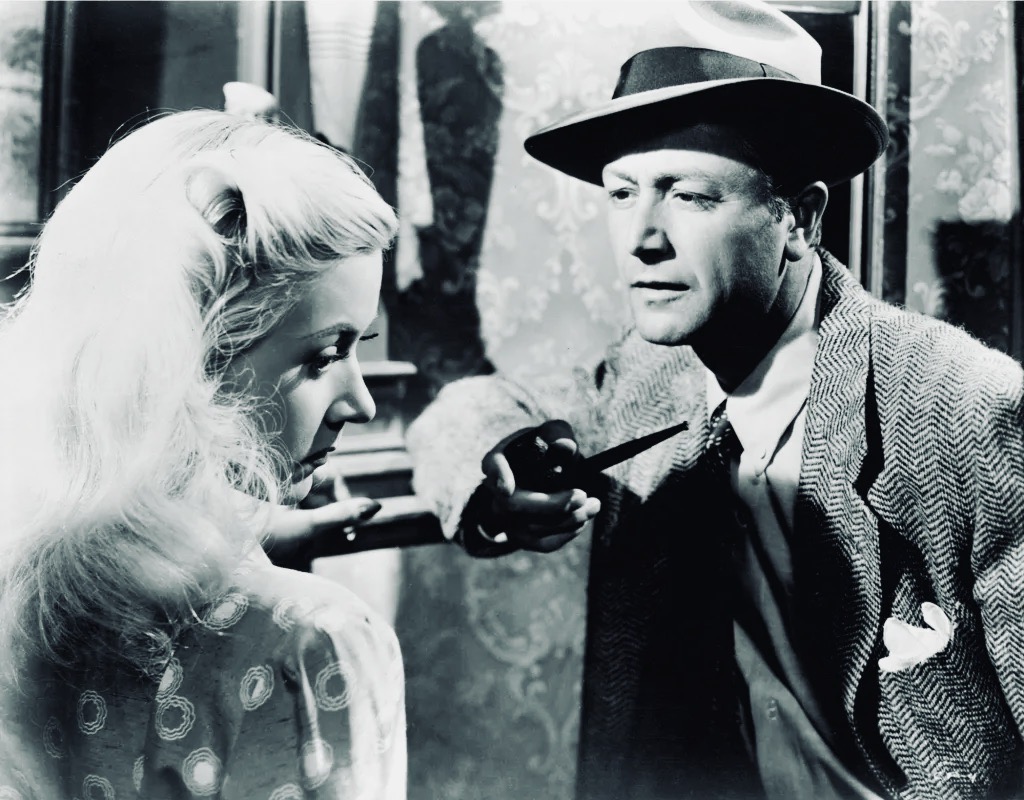
Edward Dmytryk’s Crossfire is a distinctive, one-of-a-kind film.
It was the first Hollywood B-movie to be nominated for a Best Picture Academy Award. And it was the first feature film to deal directly with the issue of antisemitism in the United States, edging out the more famous Gentleman’s Agreement by a few months.
Premiered in New York City on July 22, 1947, Crossfire was released across the country in August 1947, a little more than two years after the end of World War II and the liberation of the Auschwitz-Birkenau concentration camp by the Red Army.
Both films hit the jackpot at the box office and were nominated for Oscars.
Crossfire, which was recently screened on the Turner Classic Movies channel, received five nominations for Best Picture, Best Director, Best supporting Actor, Best Supporting Actress and Best Screenplay. Gentleman’s Agreement, directed by Elia Kazan and starring Gregory Peck, garnered eight nominations and picked up three Oscars in the categories of Best Picture, Best Director and Best Supporting Actress. Crossfire failed to win an award.
Gentleman’s Agreement, in terms of its impact on generations of movie fans, has outlasted Crossfire. Almost eight decades on, it is far better remembered as the film that fearlessly and courageously addressed this sensitive issue, at a time when it was usually swept under the rug.
Nonetheless, Crossfire is a solid, well-crafted, path-breaking film that deserves praise, respect and recognition.
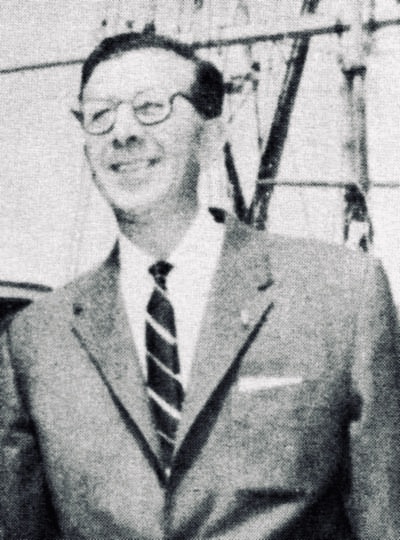
It is based on Richard Brooks’ 1945 novel, The Brick Foxhole, which focused on anti-gay prejudice. Since Hollywood’s prudish and outmoded Production Code banned any mention of homosexuality in movies, screenwriter John Paxton was forced to change the theme. At the probable suggestion of Dore Schary, RKO Picture’s Jewish chief of production, he substituted antisemitism for anti-gay bias. This was not a surprising choice, as the full magnitude of the Holocaust had just begun to emerge.
Budgeted at almost $700,000, Crossfire was filmed in only 20 days, yet it does not feel like a slapdash affair. A classic film noir ably directed by Dmytryk, a Ukrainian Canadian, it was skillfully shot by J. Roy Hunt in a bold, eerie style.
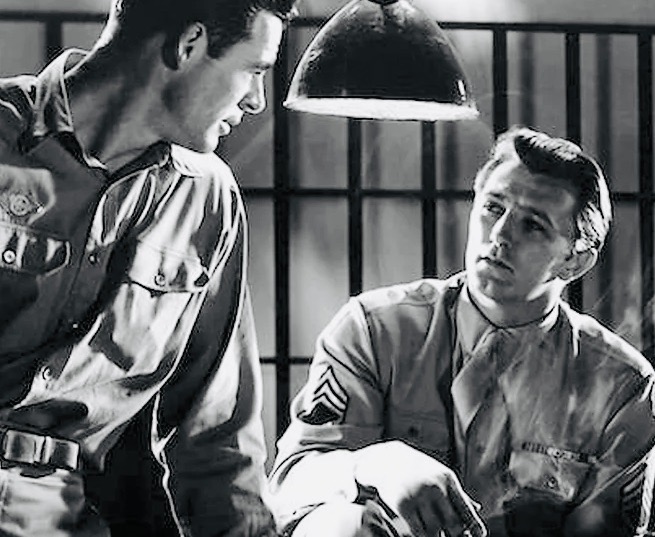
The cast, particularly Robert Young, Robert Ryan, George Cooper, Sam Levene, Robert Mitchum and Gloria Grahame, is outstanding. By all accounts, their appearance in the film enhanced their respective careers.
A taut black-and-white murder mystery 86 minutes in length, it starts on a violent note as two men engage in mortal combat, their twisting movements casting shadows on the walls of an apartment flat. Within seconds, one of the combatants lies prostrate on the floor. It is unclear why he was beaten to death.
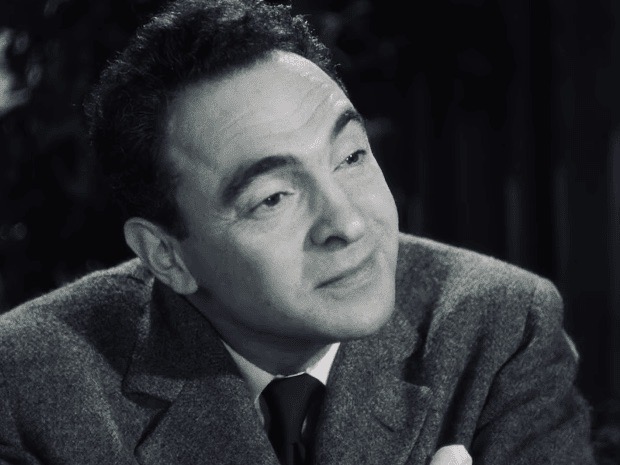
The victim, Samuels (Levene), served in the Pacific front as a soldier during the war. Finlay (Young), the sober, pipe-smoking detective assigned to the case, questions a group of soldiers who may have known him.
Suspicion falls on Mitchell (Cooper), a married soldier. When Keeley (Mitchum), his acquaintance, is summoned to police headquarters, he tells Finlay that Mitchell should be discounted as a suspect. Mitchell, however, is no angel. He exposes himself as an unfaithful husband when he cavorts with Ginny (Grahame), a world-weary floozy dancer, in a dingy bar.
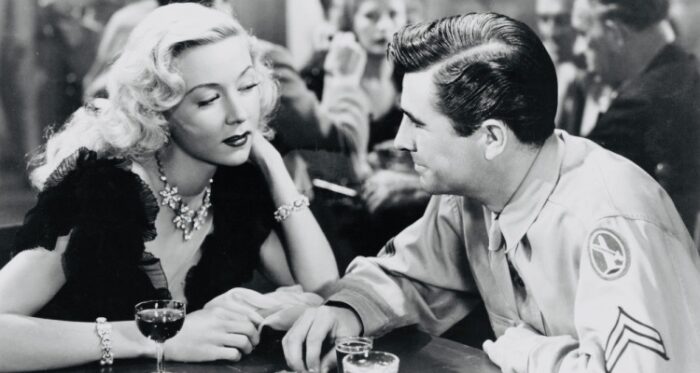
Montgomery (Ryan), another soldier, admits he encountered Samuels in a bar. In a revealing flashback, Montgomery is portrayed as a bigot. He refers to Samuels as a “Jew boy,” scathingly describing him as one of those “guys who played it safe during the war, scrounged around, keeping themselves in civvies, got swell apartments, swell dames … you know the kind. Some of them are named Samuels. Some of them got funnier names.”
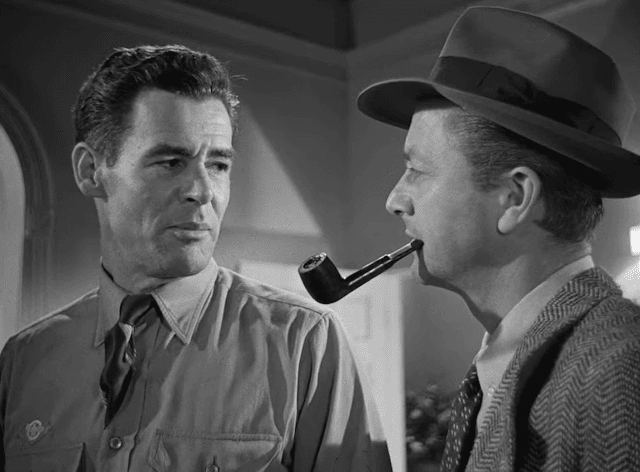
Throughout much of the film, Montgomery tries to pin Samuels’ murder on Mitchell. Finlay, an astute and methodical cop, does not buy his story. Having spoken to one of Montgomery’s acquaintances, he deciders that the murderer must have been filled with racial hatred.
In what amounts to a soliloquy, Finlay tells a haunting story to prove his point that ethnic and religious hatred is a dangerous emotion. His grandfather, an Irish Catholic immigrant, was killed by thugs solely on the basis of his ancestry. “Hating is always the same,” he observes. “One day it kills Irish Catholics, the next day Jews, the next day Protestants, the next day Quakers. It’s hard to stop.” And he adds, “Samuels was killed just because he was a Jew.”
Finlay’s definitive statement is a reflection of the deep-seated and corrosive antisemitism that tarnished American democratic ideals in the fourth decade of the 20th century. That being said, the U.S. Department of Defence was apparently hesitant about screening Crossfire. The army would show it only at bases in the United States. The navy declined to exhibit it.
On a speculative note, it is possible that the American armed forces feared that the film might not translate into a “teachable moment” and could well undermine morale in the ranks. This decision was surely indicative of the deeply conservative values and norms that governed the U.S. military in the late 1940s. Which is exactly why a film like Crossfire was so essential and important in promoting the concept of tolerance.