
Scandar Copti’s Happy Holidays seethes with potentially explosive family secrets. Unfolding in Arabic and Hebrew, and set in the northern Israeli city of Haifa, this subtle feature film explores unsettling corners of relationships and the manner in which Israeli Jews and Arab Israelis try to manage them.
It opens in theaters in the United States on December 5.
The central characters are: Rami (Toufic Danial), an Israeli Arab entrepreneur; Shirley (Shani Dahari), his Jewish girlfriend; Fifi (Manar Shehab), Rami’s sister; Walid (Raed Burbara), her boyfriend, and Fouad (Imad Hourani) and Hanan (Wafaa Aoun), the parents of Rami and Fifi.
Interestingly enough, the actors are not professionals, yet they acquit themselves professionally.
Copti draws on personal experiences. Born and raised in Jaffa, a mixed Jewish-Arab suburb of Tel Aviv, he paints an intricate picture of the social milieu in Haifa, Israel’s third largest city.

Approximately 21 percent of Israel’s population is composed of Muslim and Christian Arabs, the descendants of 160,000 Palestinians who remained in their homes after Israel’s declaration of independence in May 1948.
By choice, Israeli Jews and Arabs generally lead separate lives, but in cities such as Jaffa, Haifa, Lod and Ramle, where Arabs form a sizeable minority, they tend to mingle with Jews and, in relatively rare cases, establish romantic liaisons.
In a pivotal scene early in this two-hour film, which takes place around the Purim holiday, Shirley informs Rami that she is pregnant with his child and that she intends to carry it to term. She speaks to him in Hebrew, in a sign that Rami is linguistically integrated into Israeli society.
Rami is not ready for a baby and thinks that Shirley should have an an abortion. Hailing from a conservative family, he keeps Shirley’s pregnancy from his family, fearing it would upset his parents.
However, he unburdens himself in a conversation with his friend Walid. He says he loves Shirley, but cannot marry her. He does not explain his reasoning, but Walid instinctively understands him. Arab-Jewish unions in Israel, a Jewish state at odds with the Palestinians, tend to be fraught with problems.
Copti’s method of narration is indirect and understated. He refrains from bold assertions and declarations, preferring to work around them. His modus operandi can be opaque at times.
Copti weaves the same pattern in framing a financial crisis that suddenly besets Fouad, Rami’s father, a quiet man who has provided his family with an upper middle-class lifestyle until now. The implication is that Fouad has crossed a line and done something illegal or inappropriate, but the details remain submerged, upsetting Rami.
To cut costs, Fouad considers selling their residence. He also suggests a less ostentatious wedding for their eldest daughter. Hanan, his traditional and bossy wife, balks on both counts, possibly because she is unaware of her husband’s financial problem.
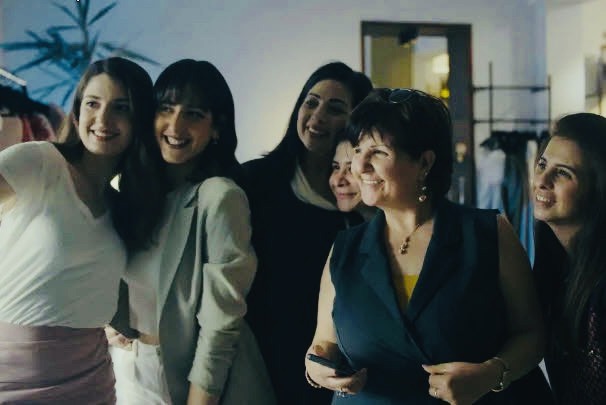
At this juncture, Copti focuses on Miri (Merav Mamorsky), Shirley’s sister. She strongly advises her to abort her pregnancy, warning that half-Arab/half-Jewish Israelis encounter identity issues.
In a superfluous subplot, Miri takes Ori, her depressed teenaged daughter, to a psychiatrist. Ori is hesitant to do her required military service. Her reluctance remains unexplained, but Copti is fixated on her refusal to join the army.
Fifi, another person who prefers secrecy to openness, dominates the last quarter of the film.
A university student, she works in a Jewish nursery where a teacher drills Zionist dogma into impressionable boys and girls. Fifi appears unmoved and uninterested in these lessons in patriotism. As an Israeli Arab, she probably finds them irrelevant, if not offensive. In keeping with Copti’s style, Fifi makes no references to these lessons. Her body language and facial movements reveal her attitude.
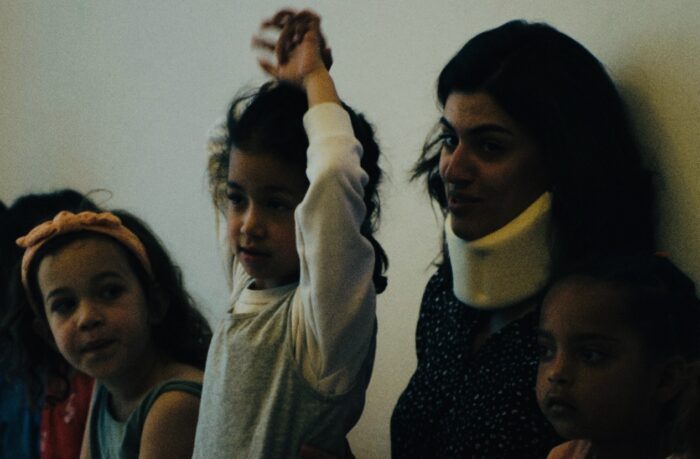
In a scene attesting to her alienation from Israeli Jewish values, she archly ignores a Memorial Day siren, when Israelis momentarily pause on sidewalks and roads to honor the fallen soldiers of Israel’s wars.
Fifi’s relationship with Walid, a doctor, grows toxic after he discovers her previous affairs with men. In a fit of anger, he denounces her as a “cheap, promiscuous girl.” By then, Fifi is determined to forge her own path.
Happy Holidays, an impassioned film that moves along at a pleasing pace and envelopes viewers, delves into these complex relationships with passion yet distance.