
The Islamic Republic of Iran has weathered another wave of anti-government protests, Iranian Foreign Minister Abbas Araghchi claimed on January 12. By his reading of the volatile situation, the regime has seized “total control” of the streets.
His claim has yet to be verified, but, as the U.S.-based Institute for the Study of War indicates, it is possible that the rate of protest activity across Iran has decreased due to the regime’s brutal crackdown on demonstrations.
In the meantime, Araghchi and other Iranian officials have blamed the United States and Israel for the violence, claiming that U.S. President Donald Trump sought a pretext to intervene in Iran’s internal affairs.
Nonetheless, Iranian diplomats have reportedly reached out to Trump’s special envoy, Steve Witkoff, to discuss the protests. The usually reliable Axios news site interpreted their outreach as an attempt by Iran to deescalate tensions with the United States.
Since early January, Trump has threatened to use military force to respond to Iran’s ferocious suppression of the demonstrations. But while U.S. air strikes are “one of the many, many options that are on the table, diplomacy is always the first option for the president,” White House press secretary Karoline Leavitt said yesterday.
Trump, meanwhile, has imposed a 25 percent tariff on nations that do business with Iran. This tariff will affect virtually every Western country as well as Russia and China, Iran’s allies.
The widespread demonstrations in Iran erupted late last month and have spilled into all its 31 provinces and major cities. They have shaken the theocratic regime, with clashes having broken out between usually peaceful protesters and security forces.
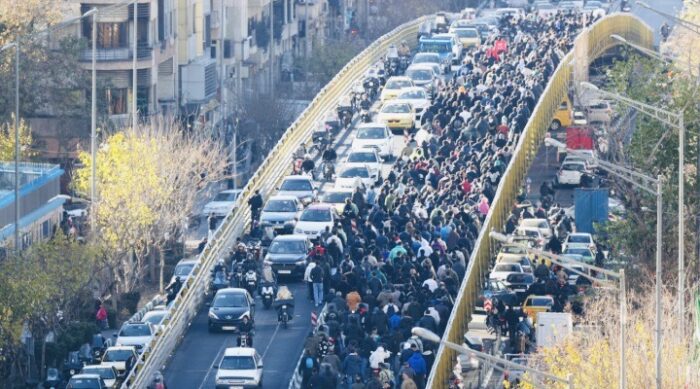
The protesters appear to lack an organized leadership. As one observer put it, “The regime has been systematic and ruthless in eliminating potential leaders. What remains is an angry public that can take to the streets but cannot take control.”
Since the outbreak of the current unrest, upwards of 2,000 people have been killed and some 10,000 have been arrested, according to a Reuters report based on information released by an unidentified Iranian official. The exact number of casualties and detainees cannot be ascertained because the authorities have shut down the internet.
As might have been expected, the regime has highlighted the counter-demonstrations mounted by pro-government protesters, who have chanted “Death to America!” and “Death to Israel!”
All other protesters have been denounced as “terrorists,” suggesting that they will be subjected to further repression.
Iran’s 86-year-old supreme leader, Ayatollah Ali Khamenei, has blasted the anti-regime demonstrators as “enemies of the Islamic Republic” and a “bunch of vandals” trying to “please” Trump. Asserting that “rioters should be put in their place,” he has vowed that the regime will “not back down.”
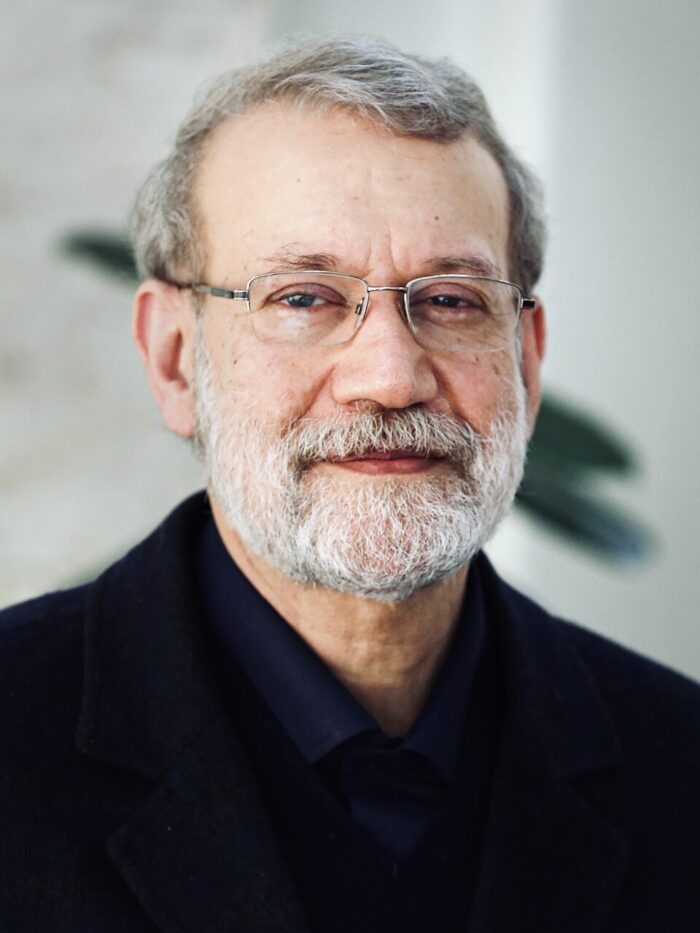
Ali Larijani, the secretary of the Supreme National Security Council, has made a distinction between protesters with legitimate economic demands and “urban semi-terrorists” who conduct armed attacks.
Iran’s prosecutor general, Mohammad Movahedi Azad, has said that legal proceedings against demonstrators should be “without leniency, mercy or appeasement.” He has warned that “all criminals involved” in protests would be considered an “enemy of God,” a charge that carries the death penalty in Iran.
President Masoud Pezeshkian has acknowledged the public’s “legitimate” grievances and the regime’s responsibility to address them. In a bid to tamp down tension, he sacked the director of the central bank and replaced him with Abdolnaser Hemmati, a former economy minister.
Newspapers affiliated with the Islamic Revolutionary Guards Corps have repeatedly described the protesters as “terrorists” and compared them to Islamic State operatives in an effort to justify Iran’s harsh response.
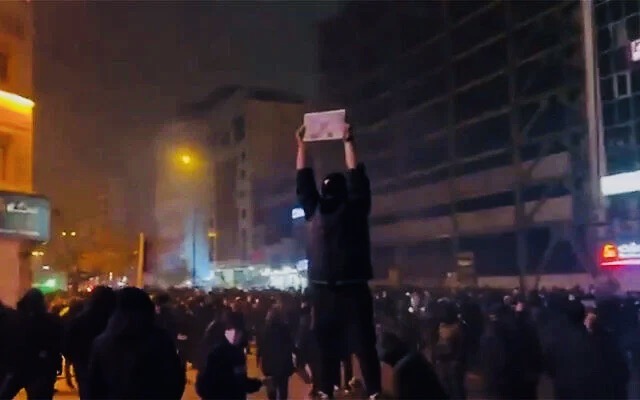
The protests broke out on December 28 in Tehran’s central bazaar, a hub of commerce, after two related events. The national currency, the rial, plunged to record lows against the U.S. dollar. Inflation approached the 40 percent mark, sending the cost of living soaring beyond the means of ordinary Iranians.
Biting U.S. and European economic sanctions have exacerbated Iran’s dire economic problems.
The demonstrations have been among the most intense since the downfall of the Pahlavi monarchy and the emergence of the Islamic revolution in 1979. They have rapidly expanded to encompass broader grievances over government corruption, mismanagement of the economy, and rigid clerical rule. Some protesters have demanded the ouster of the Islamic Republic.
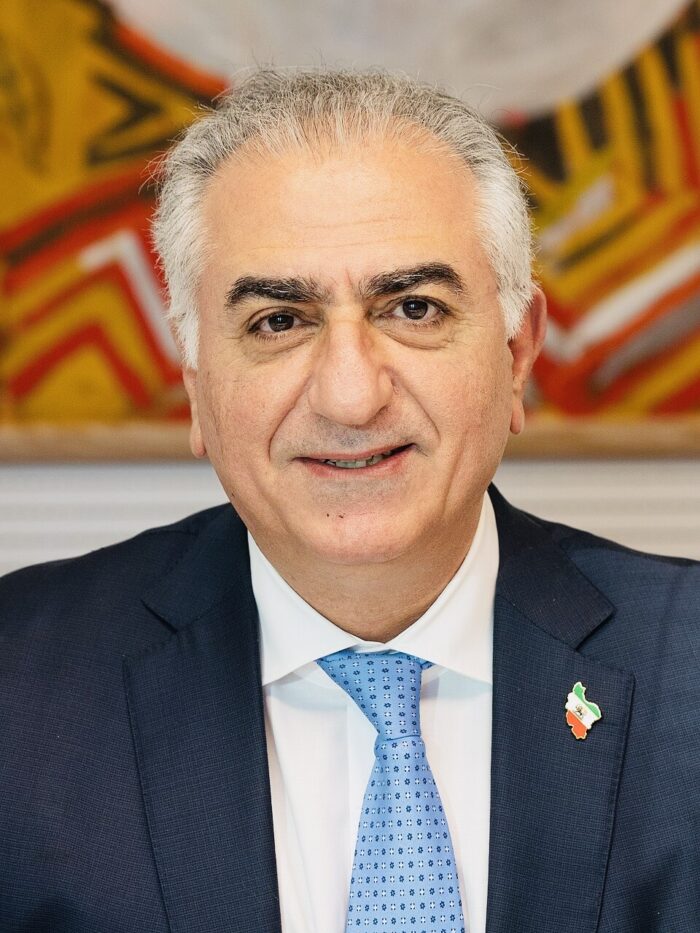
The exiled Iranian crown prince, Reza Pahlavi, whose father Shah Mohammed Reza Pahlavi was driven out of the country, has advocated regime change. “We need to cut the snake’s head off for good so it can no longer be a threat to Iranian interests, to American interests, to regional interests,” he said. “And the only solution is to make sure this regime goes down for good and the Iranian people can liberate themselves.”
Prior to the latest protests, Iran was grappling with severe water shortages and growing air pollution and facing the prospect of another round of air strikes by the United States and Israel.
Last June, Israel and Iran fought a 12-day war during which the Israeli Air Force heavily damaged Iran’s nuclear and ballistic missile facilities and killed scores of Iranian army commanders and nuclear scientists. The hostilities claimed the lives of about 1,100 Iranians. Toward the close of the war, U.S. air and naval forces bombed three Iranian nuclear sites. Trump claimed they had been “obliterated.”
In retaliation, Iran fired missiles at Israeli cities, killing 31 civilians, and struck a U.S military base in Qatar.
To no one’s surprise, Khamenei has accused outside forces of seeking to sabotage Iran’s stability. His nemesis, Israeli Prime Minister Benjamin Netanyahu, has done nothing to refute that accusation. As he said recently, “We all hope that the Persian nation will soon be freed from the yoke of tyranny. And when that day arrives, Israel and Iran will once again become faithful partners in building a future of prosperity and peace.”
Israel and Iran had normal diplomatic relations until the Islamic revolution. Since then, Iran has morphed into Israel’s deadliest enemy, supplying regional surrogates such as Hamas and Hezbollah with military, financial, logistical and political support.
Mohammad Ghalibaf, the Speaker of Iran’s Parliament, has threatened to attack Israel and American bases in the Middle East if the United States takes military action against Iran.
The turmoil currently gripping Iran reminds observers of previous perilous periods of unrest.
Iran confronted mass protests in 2009 after critics disputed the victory of the then-president, Mahmoud Ahmadinejad, and claimed widespread electoral fraud. In a show of resistance, millions of Iranians took to the streets, with social media playing a significant role in mobilizing the crowds. The regime crushed the uprising, killing dozens of demonstrators, arresting thousands, and tightening censorship.
A decade later, new protests erupted following a sudden jump in fuel prices. The rallies spread to some 20 cities, and the authorities reacted violently.
In 2022, the death of Jina Mahsa Amini in police custody triggered outrage and nation-wide protests, posing one of the greatest challenges to the regime in decades. She was arrested by morality police for allegedly not wearing her headscarf, or hijab, properly in public. The protesters demanded more rights for women. The regime reacted with a wave of repression, killing scores of protesters and imprisoning thousands.
It remains to be seen whether the regime can really suppress the latest unrest and survive. What is certain is that many Iranians despise it and want it gone.
Friedrich Merz, the chancellor of Germany, told a press yesterday that the regime is tottering. “If a regime can only cling to power through violence, then it’s effectively over anyway. I believe that we are currently witnessing the final days and weeks of this regime.”
Many Iranians hope he is right.