
Mundek Lukawiecki’s son, Simon, knew nothing about his father’s past until he was an adult. A survivor of the Holocaust in Poland, Lukawiecki did not talk about that horrendous period and acted as if the mass murder of Polish Jews had never even occurred.
In 1993, Lukawiecki switched course, telling his story to Yad Vashem, the Holocaust memorial and museum in Jerusalem. The news that his father had been a partisan in the forests of Poland for three years shook Simon to the core. As he says in Ruth Walk’s documentary, The Partisan With The Leica Camera, this revelation turned his world on its head.
Now available on the Izzy streaming platform, Walk’s movie is worth viewing if only for one compelling reason. Lukawiecki may well have been the sole partisan in the Armia Krajowa (AK), the main Polish underground army battling the Germans during the Nazi occupation, to leave a photographic record of his service. For security reasons, AK partisans were forbidden to take photographs, but Lukawiecki silently flouted that rule.
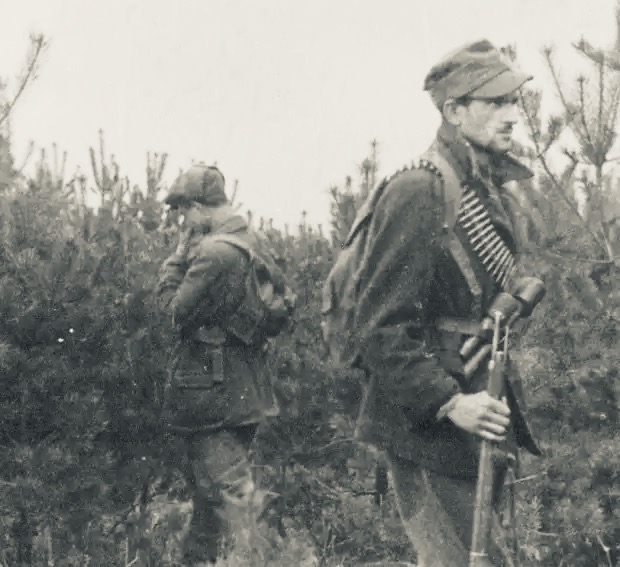
After Lukawiecki’s death in 2004, Simon found his rare photographs in an album and gifted them to Yad Vashem.
Walk’s film, which focuses on Simon’s discovery and his father’s stint in the AK, begins in the late 1950s, when he and his parents lived in Ramat Gan, a suburb of Tel Aviv.
Lukawiecki and his wife, Hanna, a survivor herself, had a stormy marriage. Lukawiecki usually kept to himself, yet neighbors who encountered him thought he was incredibly charming and the epitome of a Polish gentleman.
The Lukawieckis arrived in Israel in 1948, the year Israel emerged as a sovereign and independent state and four years after the Soviet Red Army liberated them. They settled in Acre, a city near the port of Haifa, where Lukawiecki found employment as a photographer in the Israeli army.
He had been an avid photographer in Lvov, where he bought a German-made Leica camera to pursue his ardent interest in photography. After leaving the army, he opened a studio in Acre. He then moved his business to Jaffa, a mixed Jewish-Arab neighborhood south of Tel Aviv.
Walk jumps around a lot before finally concentrating on his role as a partisan. In 1943, at the age of 22, he was appointed a company commander of a band in the Narrol forest.
His fellow fighters did not know he was Jewish, an important point that Walk glosses over. Some AK bands rejected Jews. Still others only tolerated them. Walk should have delved into this issue, since antisemitism was a real problem in Poland before, during and after World War II. Yet Walk pays no attention to it, a major oversight.
She tells us that Lukawiecki’s band killed German soldiers and assassinated local collaborators, but she provides no details. Nor does she explain where the partisans obtained their arms and munitions and how they lived off the land.
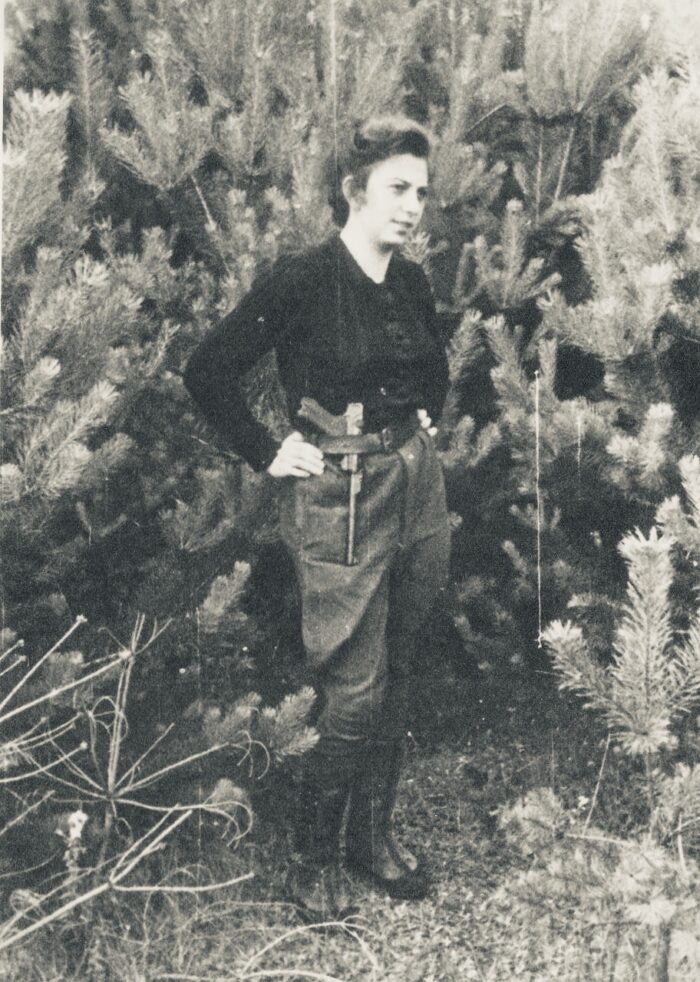
We learn that Lukawiecki met his wife-to-be, Hanna Bern, then 16, while secretly visiting the Lubaczow ghetto, which was close to his base. Hanna’s father, fearing that the Germans would murder its Jewish inhabitants, begged him to take her into the forest with him.
After joining the band, Hanna was raped. In retribution, she killed her assailant. She and Lukawiecki killed a Ukrainian family that had betrayed a Jew to the Germans for a kilo of sugar and vodka.
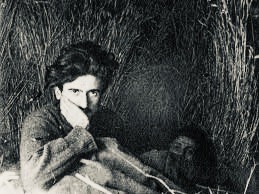
At this point, in an abrupt transition, Walk returns to Ramat Gan. Simon recalls that his father was a strict disciplinarian who tyrannized his family and communicated with them through the medium of his photographs.
The Partisan With The Leica Camera is generally an interesting film, but due to its glaring omissions and choppy transitions it sometimes falls flat. With further editing, it could be a far better film.